Fireworks AI
Cloud inference platform for running and fine-tuning open-source language models fast, without owning any GPUs.
🔗 Visit Fireworks AI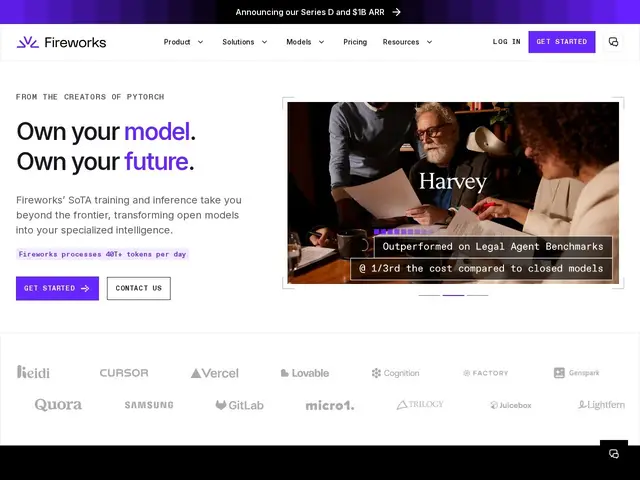
Description
Running a large language model yourself means renting expensive graphics cards, keeping them busy enough to be worth the cost, and tuning a lot of infrastructure just to answer questions quickly. Fireworks AI removes that whole layer of work: you send a request to an API, an open-source model answers it on infrastructure Fireworks already built and optimized for speed, and you pay only for what you use.
Fireworks AI is a cloud inference platform offering 40+ optimized open-source language models through OpenAI- and Anthropic-compatible APIs, so switching from a proprietary model provider is usually a small code change rather than a rewrite. It supports serverless per-token billing for pay-as-you-go usage, on-demand and reserved dedicated GPU deployments for predictable heavy workloads, and fine-tuning (supervised, preference-based and reinforcement learning methods, including cheaper LoRA-based tuning) for teams that need a model adapted to their own data. Pricing for serverless inference starts around $0.10 per million tokens for smaller models and scales up by model size, dedicated GPUs run roughly $7-$12/hour depending on the hardware tier (H100 through B300), and fine-tuning is priced per million training tokens starting near $0.50/1M for LoRA. The company raised a large Series D round in mid-2026, reflecting how central inference infrastructure has become to the AI stack.
💬 Our review
The short version: Fireworks AI is a credible, fast alternative to running your own GPU infrastructure or paying closed-model API prices, and the OpenAI/Anthropic-compatible API makes it genuinely low-friction to try.
The category — serverless open-model inference — is now a real three-way race between Fireworks, Together AI and Groq, and none of them is a clear universal winner: Together AI's per-token pricing is broadly similar and its model catalog just as broad, while Groq differentiates on raw inference speed with its custom LPU hardware rather than GPU-based serving. Fireworks' fine-tuning story (LoRA, SFT, DPO, RL, all in one platform) is a genuine edge over providers that only offer inference — if you need to adapt a model to your own data as well as serve it, that consolidation is worth paying for; if you only need vanilla inference on a popular open model, price-shopping across Fireworks, Together and Groq for your specific model is worth the ten minutes it takes.
💰 Pricing
📊 Global score
🤖 AI-enriched data
Serverless from ~$0.10/1M input tokens (small models) up to $0.90/1M (large models). Dedicated GPU: $7-$12/hr (H100 to B300). Fine-tuning from ~$0.50/1M training tokens (LoRA).
Pros
OpenAI/Anthropic-compatible API — low-friction migration from closed-model providers
Fine-tuning (SFT, DPO, RL, LoRA) bundled alongside inference, not a separate product
Both serverless per-token and dedicated GPU deployment options
Cons
Pricing is broadly comparable to Together AI — little differentiation on cost alone
Groq's custom hardware beats it on raw inference speed for supported models
Dedicated GPU pricing ($7-12/hr) requires real usage volume to justify over serverless