Firecrawl
Web scraping and crawling API that turns entire websites into clean, structured data ready for AI models to read.
🔗 Visit Firecrawl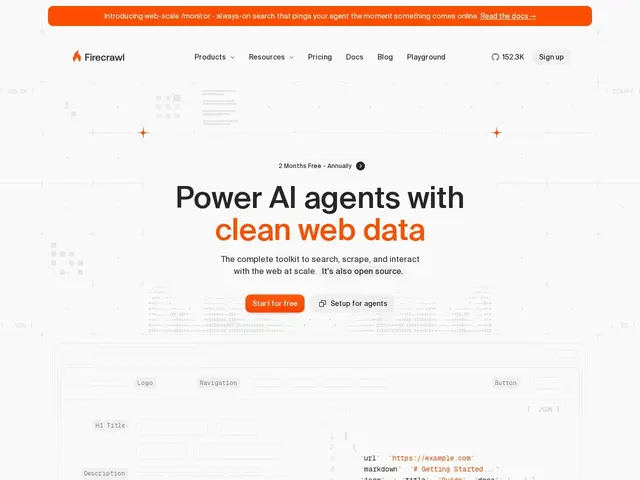
Description
AI models are good at reasoning over text, but the web is messy — full of ads, navigation menus, cookie banners and JavaScript that a model can't easily parse. Someone has to clean all that up before an AI app can actually use a webpage as a source. Firecrawl is that cleanup crew: point it at a URL, and it hands back tidy, readable content instead of a tangle of HTML.
Firecrawl is a web scraping and crawling API purpose-built for feeding AI systems: it converts pages into markdown, JSON or screenshots, handles JavaScript rendering and dynamic content, can click and scroll through interactive pages, extracts structured data against a JSON schema you define, and can crawl or map an entire site rather than one page at a time. It's aimed at teams building RAG pipelines, AI research agents, lead enrichment tools and competitive intelligence systems that need reliable web data at scale. The core project is open source (AGPL-3.0, with some MIT-licensed components) with roughly 40,000 GitHub stars. Pricing runs from a free tier (1,000 pages/month) through Hobby at $16/month (5,000 pages), Standard at $83/month (100,000 pages), Growth at $333/month (500,000 pages), Scale at $599/month (1M pages), up to custom Enterprise plans.
💬 Our review
The short version: Firecrawl earns its popularity — it solves the specific, tedious problem of turning raw web pages into AI-ready text, and being open source means a team that outgrows the hosted API isn't stuck paying forever.
The honest comparison is against generic scraping infrastructure (Apify, Bright Data, ScrapingBee), which are more mature and offer broader proxy/anti-bot tooling but weren't built with LLM output formats in mind — Firecrawl's markdown-and-JSON-schema-first design saves real integration work if your end consumer is an AI model. The pricing scales roughly linearly with page volume, which is fair but adds up fast for high-crawl-frequency use cases; a team scraping the same handful of pages repeatedly for monitoring is better served by a cheaper, more specialized tool, while Firecrawl is the right call for AI apps that need broad, structured web coverage on demand.
💰 Pricing
📊 Global score
🤖 AI-enriched data
Free: 1,000 pages/month. Hobby: $16/mo, 5K pages. Standard: $83/mo, 100K pages. Growth: $333/mo, 500K pages. Scale: $599/mo, 1M pages. Enterprise: custom.
Pros
Open source (AGPL-3.0) with a large, active community (~40k GitHub stars)
Output formats (markdown, JSON schema) designed specifically for LLM consumption
Handles JavaScript rendering, clicking and scrolling on dynamic pages, not just static HTML
Cons
Pricing scales with page volume — high-frequency crawling gets expensive fast
Less mature proxy/anti-bot infrastructure than dedicated scraping platforms like Bright Data
AGPL license on the core project has copyleft implications for some commercial self-hosting