Blaxel
Cloud infrastructure for running autonomous AI agents at scale, with millisecond sandbox startup and near-zero idle cost.
🔗 Visit Blaxel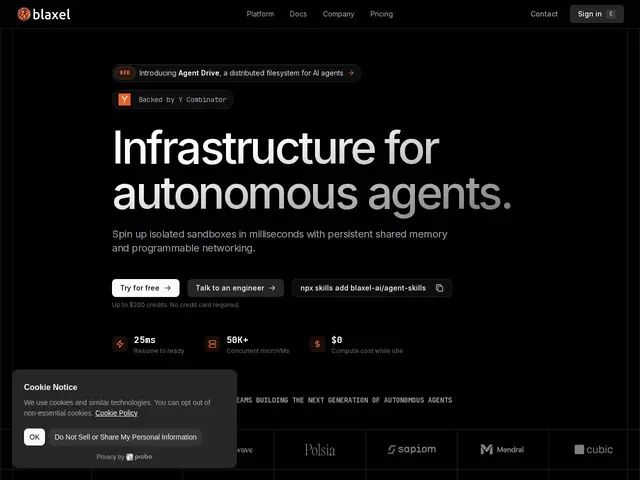
Description
Running one AI agent for a demo is easy. Running thousands of agents that each need their own isolated computer, that start instantly when work arrives and cost nothing while sitting idle, is a different engineering problem entirely — one most teams shouldn't have to solve themselves. Blaxel is infrastructure built specifically for that job: it hands each agent a disposable sandbox that boots in milliseconds and disappears (and stops costing money) the moment it's done.
Blaxel is agent-execution infrastructure that supports over 50,000 concurrent microVMs, with sandboxes booting in milliseconds and resuming from a paused state in roughly 25ms — fast enough that agents can be spun up per-task rather than kept running continuously. It includes Agent Drive, a distributed filesystem for sharing state across multiple agents working together, persistent durable volumes for data that needs to survive between runs, and a programmable network layer with egress control and static IPs for agents that need a stable, whitelistable identity when calling external APIs. Founded in 2024 and backed by Y Combinator, Blaxel prices on a pay-as-you-go basis (around $0.0000115 per GB-RAM-second of compute, plus $0.12/GB-month for storage), starts new accounts with $200 in free credits, and offers optional flat-rate subscription tiers from $20/month.
💬 Our review
The short version: Blaxel's real selling point is cost efficiency at idle — zero compute charges when an agent isn't actively running is exactly what you want for a fleet of agents that spend most of their time waiting for the next task, not running continuously.
It's competing directly with E2B, Modal and Daytona in a category that got very busy in 2026, and on paper the numbers are competitive rather than obviously superior — the ~25ms resume time is genuinely fast, but E2B's sub-200ms cold start and Modal's broader GPU/serverless platform are both credible alternatives depending on what else you need bundled in. Agent Drive, the shared distributed filesystem for multi-agent collaboration, is the more distinctive feature and the reason to pick Blaxel specifically over a single-agent sandbox provider: if your workload is one agent running scripts, any of the competitors will do; if it's multiple agents that need to share state and files while working together, Blaxel's architecture is built for exactly that.
💰 Pricing
📊 Global score
🤖 AI-enriched data
$200 free credits. Pay-as-you-go: ~$0.0000115/GB RAM-second compute, $0.12/GB-month storage. Optional subscription tiers from $20/month.
Pros
Zero compute cost while agents are idle, not just cheap — actually free
Supports 50,000+ concurrent microVMs with ~25ms resume from pause
Agent Drive shared distributed filesystem built for multi-agent collaboration
Cons
Crowded category with strong, well-funded competitors (E2B, Modal, Daytona)
No open-source core, unlike E2B's SDK
Pay-as-you-go pricing requires modeling usage carefully to predict real cost