Alloy
Identity and fraud decisioning platform that connects a single API to 270+ data providers, letting banks and fintechs orchestrate KYC/KYB, fraud and transaction monitoring across the whole customer lifecycle.
🔗 Visit Alloy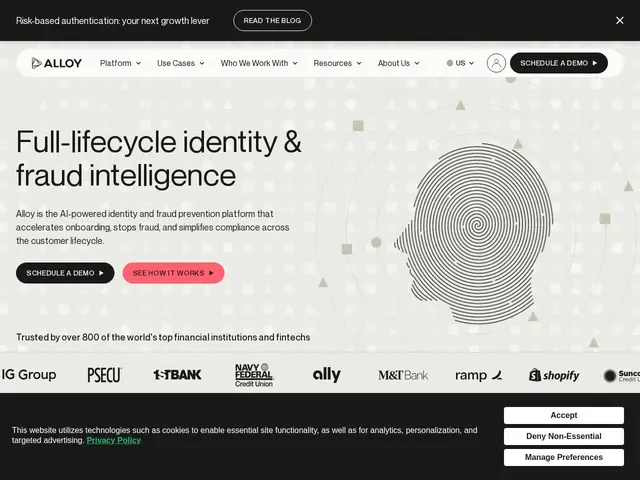
Description
No single identity-verification or fraud-detection vendor is the best choice for every customer, every country, or every kind of fraud pattern — so banks and fintechs end up needing several data providers at once, which normally means separately integrating with each one. Alloy sits in front of all of them: one API and one set of rules that decides, behind the scenes, which combination of providers to check for any given customer or transaction.
Alloy is an identity verification and fraud prevention orchestration platform connecting financial institutions to 270+ third-party data providers through a single API. It handles KYC/KYB verification, continuous perpetual risk screening, AML compliance, transaction monitoring (P2P, ACH, RTP/FedNow, wire, card, and stablecoin), and AI-powered fraud detection tools (Fraud Signal, Fraud Attack Radar) across the entire customer lifecycle, not just at signup. It serves 800+ financial institutions including banks, credit unions, sponsor banks and crypto firms, and is backed by Bessemer, Lightspeed and Canapi.
💬 Our review
The short version: Alloy is for banks and fintechs that already need multiple identity/fraud data providers and want one orchestration layer instead of maintaining separate integrations and rule engines for each.
The key distinction from Persona, Jumio or Onfido is architectural — those are verification providers themselves, while Alloy is a decisioning layer that routes across many providers (including, in many setups, providers like Persona) based on rules a company configures, which matters because no single vendor performs best across every segment, geography or fraud pattern. That orchestration flexibility is exactly why it's aimed at regulated financial institutions rather than a consumer marketplace — the transaction-monitoring and stablecoin coverage in particular reflects a much heavier compliance burden than most startups carry. As with every enterprise fintech-infrastructure platform in this space, pricing is entirely custom and gated behind sales, so there's no way to self-serve a cost estimate; this is squarely built for banks, credit unions and crypto firms managing real regulatory risk, not for a startup that just needs to verify a signup's ID once.
💰 Pricing
📊 Global score
🤖 AI-enriched data
Custom pricing; contact sales, no public tiers or self-serve signup.
Pros
Orchestrates 270+ data providers behind a single API instead of many separate integrations
Covers the full customer lifecycle, not just onboarding — transaction monitoring, AML, perpetual risk screening
AI-powered fraud detection tools purpose-built for financial-services fraud patterns
Proven at scale serving 800+ financial institutions
Cons
No public pricing — enterprise sales process required for a quote
Overkill for a company that just needs single-provider identity verification, not orchestration
Built specifically for regulated financial institutions, not general SaaS/consumer apps