Hopsworks
Managed feature store and AI lakehouse platform for building production machine-learning systems with millisecond-latency feature serving.
🔗 Visit Hopsworks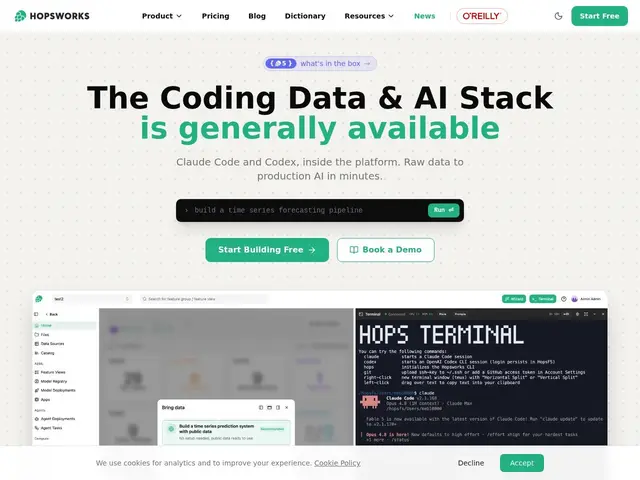
Description
Think of Hopsworks as a combined warehouse-and-delivery-service for the data a machine learning model needs: it stores all the historical data for training in one place, and separately keeps a fast, always-ready copy for the split-second lookups a live model needs when making a real prediction — like a fraud check that has to happen before a payment finishes.
Hopsworks is a unified platform combining a feature store, an "AI Lakehouse" (supporting Delta, Iceberg and Hudi table formats), and MLOps tooling — experiment tracking, model registry, and deployment pipelines — in one product. Its feature store serves online lookups at sub-millisecond latency and integrates with Ray, Spark, Flink and DuckDB for compute at scale, including GPU management for training and newer agent-deployment capabilities added in version 5.0. The core is AGPL-3.0 open source (github.com/logicalclocks/hopsworks, 1.3k stars), with a free tier limited to one project, pay-as-you-go SaaS pricing for unlimited projects, and Enterprise plans that include on-premise deployment. Customers include Zalando and Clicklease, spanning financial services, retail and government.
💬 Our review
The short version: Hopsworks bundles what Feast, an MLOps platform, and a lakehouse each do separately into one product — worth it if you want fewer moving parts, at the cost of being more opinionated than stitching together best-of-breed open-source tools yourself.
Sub-millisecond online feature serving is a genuine technical differentiator for latency-sensitive use cases like fraud detection or real-time recommendations, and bundling the feature store with experiment tracking and model registry means teams don't have to separately wire up MLflow-style tooling on top. AGPL-3.0 licensing does make it open source, but AGPL is a stricter copyleft license than Feast's Apache-2.0 — worth checking against your company's license policy before adopting the self-hosted route. The honest trade-off: it's a heavier, more all-in-one platform than a single-purpose feature store, so teams that already have their own MLOps and lakehouse tooling may find some of Hopsworks redundant rather than additive. For teams starting fresh and wanting an integrated feature-store-plus-MLOps platform, Hopsworks is a credible one-stop option; teams that want a lightweight, unopinionated feature store to slot into an existing stack should look at Feast instead.
💰 Pricing
📊 Global score
🤖 AI-enriched data
Free tier: 1 project, no credit card required. SaaS: pay-as-you-go, unlimited projects. Enterprise: custom pricing, includes on-premise deployment.
Pros
Sub-millisecond online feature serving
Bundles feature store, lakehouse and MLOps in one platform
Supports Delta, Iceberg and Hudi table formats plus Ray/Spark/Flink compute
Cons
AGPL-3.0 is a stricter copyleft license than Apache-2.0 alternatives
More opinionated/heavier than a single-purpose feature store