WebMCP Stack
Turns OpenAPI specs into safe, typed tools that AI agents can call, without manual wiring.
🔗 Visit WebMCP Stack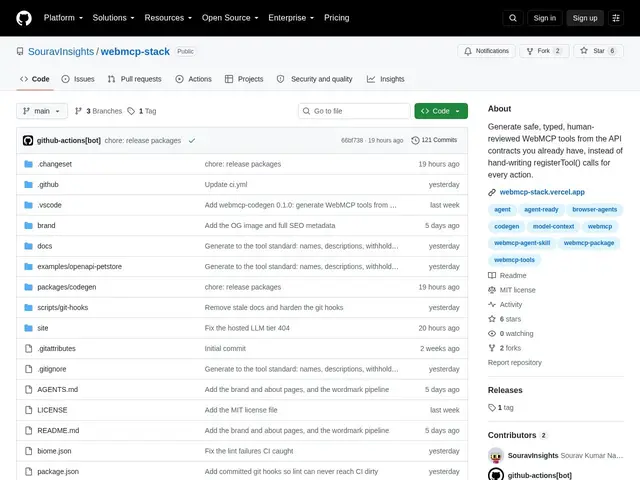
Description
If you've ever wanted an AI agent to actually use your API — book something, update a record, trigger an action — you normally have to hand-write a description of every endpoint so the agent knows it exists and how to call it safely. WebMCP Stack skips that step: point it at your OpenAPI spec and it automatically generates ready-to-use agent tools, complete with a label for how risky each one is (read-only vs. one that deletes data).
Technically, it's an open-source (MIT) code generator: it emits typed, ownable TypeScript rather than wrapping your API in a black-box runtime, so you keep the generated code in your own repo instead of depending on the tool at runtime. Endpoints get automatically classified into read/write/destructive tiers, with destructive and webhook/auth endpoints disabled by default until a developer explicitly turns them on. It's an early-stage project (single-digit GitHub stars, ~120 commits) built specifically for the emerging WebMCP/agent-tools ecosystem, currently limited to OpenAPI as an input source.
💬 Our review
The short version: a clever, narrowly-scoped generator that solves a real annoyance (manually wiring API endpoints into agent tools) — but it's a brand-new, single-maintainer project, so treat it as an interesting building block rather than infrastructure you'd bet production on today.
Compared to hand-rolling tool definitions with LangChain or a similar agent framework, WebMCP Stack's pitch is speed and safety-by-default: generate once from a spec you already maintain, get sane risk classification for free, and keep the code rather than a runtime dependency. The catch is maturity — no audit/telemetry layer yet, OpenAPI-only input, and a commit history measured in weeks, not years. Worth trying if you're already building WebMCP-style agent tools and want to skip boilerplate; not yet a safe bet if you need long-term support guarantees.
💰 Pricing
📊 Global score
🤖 AI-enriched data
Gratuit, licence MIT, générateur de code auto-hébergé.
Pros
Code généré et détenu par le dev
Classification de risque automatique
Gratuit et open source
Cons
Projet très jeune (peu d'étoiles)
OpenAPI seul comme source
Pas d'audit/télémétrie