Voiden
Free, open-source, offline-first API workspace that stores requests as plain-text Markdown files versioned in Git.
🔗 Visit Voiden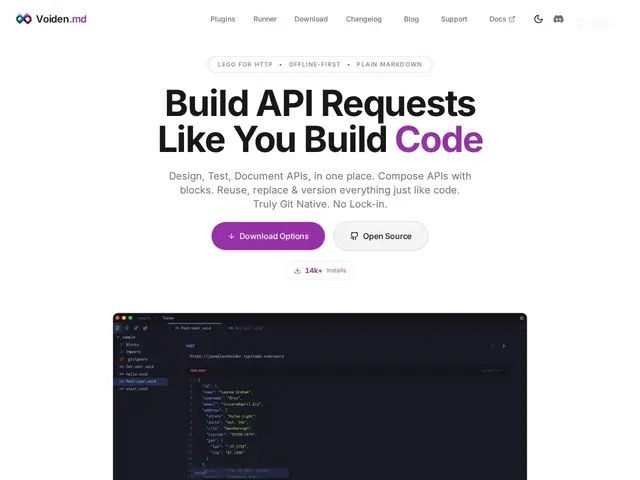
Description
Tools like Postman let you design and test API requests, but they store everything in a cloud account, which means your team's API collections live outside your codebase — syncing them, reviewing changes, or working offline is always a bit awkward. Voiden takes a different approach: it saves each API request as a plain text file (in a format based on Markdown) that lives right in your project's Git repository, so you get version history, code review, and offline access for free, using tools you already use every day.
Voiden is a free, open-source (Apache 2.0), Electron-based desktop app for designing, testing, and documenting APIs, available on macOS, Windows, and Linux through package managers like Homebrew, APT, Snap, and Nix. It requires no account and sends no telemetry, supports composable reusable request blocks, and ships a headless CLI runner (@voiden/runner) for CI/CD pipelines. With about 1.7k GitHub stars and 14k+ installs, it's a smaller but genuinely active alternative to Postman and Insomnia.
💬 Our review
The short version: Voiden is a compelling pick for teams that want their API workspace to live in Git rather than in someone else's cloud, and being completely free removes any financial risk in trying it — the only real cost is a learning curve if your team isn't already comfortable with Git-based workflows.
Against Postman and Insomnia — the two dominant players — Voiden's whole reason to exist is the Git-native, offline-first model: no account, no cloud sync friction, no vendor lock-in, and your API collections review like code because they are code (plain-text `.void` files). The tradeoff is community size: 1.7k GitHub stars is real traction for a young tool but nowhere near Postman's ecosystem of integrations, team features, and mock servers. As an Electron app it also carries more memory overhead than a lightweight CLI tool. Worth adopting if your team already lives in Git and values ownership over convenience; stick with Postman if you need deep team collaboration features or a large integration marketplace today.
💰 Pricing
📊 Global score
🤖 AI-enriched data
Free and open source, no paid tiers
Pros
Git-native, version-controlled API definitions
Offline-first, no account
Free and open source
CI/CD headless runner
Cons
Smaller community than Postman/Insomnia
Electron memory overhead
Requires Git familiarity