Open Wearables
Open-source, self-hosted API that unifies data from Apple Health, Garmin, Whoop, and Oura into AI-powered health insights.
🔗 Visit Open Wearables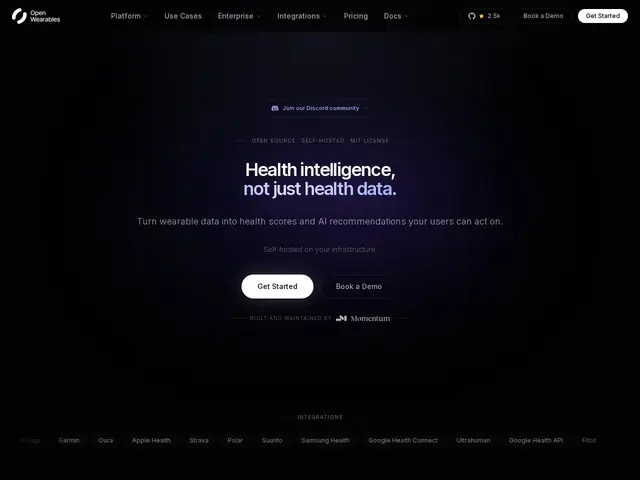
Description
If you own an Apple Watch, a Garmin, a Whoop band, and an Oura ring, each one keeps your health data in its own separate app, and there's no easy way for a developer to build something that looks at all of it together. Open Wearables solves that by giving developers one single, consistent way (an API) to pull in data from all these devices at once, then adds AI-powered scoring — like a sleep score or a "resilience" score — on top, so building a health app doesn't mean writing separate code for every wearable brand.
It's fully open-source under the MIT license, built with FastAPI (Python), React, PostgreSQL, and Redis, and designed to be self-hosted with HIPAA-eligible infrastructure — meaning companies handling sensitive health data can keep full control instead of trusting a third-party API vendor. With 2.5k GitHub stars, it targets health product teams and SaaS companies that need compliance-ready wearable integration without vendor lock-in, competing against closed-source aggregators like Validic and Apple's own HealthKit.
💬 Our review
The short version: Open Wearables is a smart, developer-friendly answer to the fragmented wearable-data landscape, and being open-source with transparent, auditable health-scoring algorithms is a real trust advantage for anything touching medical or compliance-sensitive use cases — but you need real self-hosting capacity to use it.
Compared to closed-source aggregators like Validic, Open Wearables' MIT license and full source-code transparency mean you can audit exactly how a "resilience score" is calculated instead of trusting a black box — genuinely important if you're building something clinical or compliance-adjacent. The tradeoff is that self-hosting HIPAA-eligible infrastructure is real operational work, and enterprise pricing is proposal-based rather than posted publicly, so budgeting up front is harder than with a plug-and-play SaaS API. Worth it for teams that specifically need compliance, auditability, or vendor independence; a hosted aggregator API will get a simple health app to market faster if you don't have those requirements.
💰 Pricing
📊 Global score
🤖 AI-enriched data
Free (self-hosted, MIT); Enterprise pricing on request
Pros
Unified multi-wearable API
Fully open-source and auditable
HIPAA-eligible self-hosting
AI health scoring
Cons
Requires self-hosting infrastructure
Enterprise pricing not public
Fewer built-in integrations than dedicated aggregators