OpenLIT
Open-source, self-hosted observability platform for LLM applications, built on OpenTelemetry.
🔗 Visit OpenLIT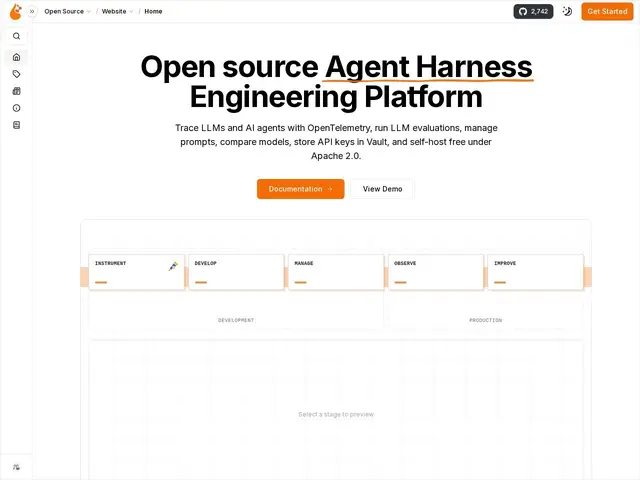
Description
OpenLIT is a free, self-hosted dashboard that shows you what's actually happening inside an AI application — which prompts got sent, how much each call cost, how long it took, and whether the output was any good — the same way an electricity meter shows what's consuming power in your house, except here the "appliances" are calls to OpenAI, Anthropic, or any other LLM provider.
Built on OpenTelemetry (an open industry tracing standard), OpenLIT auto-instruments 50+ LLM providers, AI frameworks and vector databases with a single line of code, then layers on prompt versioning, LLM-as-a-judge evaluation, side-by-side model comparison, cost tracking, and GPU monitoring across NVIDIA, AMD and Intel hardware. It's Apache 2.0 licensed and self-hosted, so there's no per-seat SaaS fee and no data leaving your infrastructure.
💬 Our review
The short version: OpenLIT is a solid, free, self-hosted way to get LLM observability without paying a SaaS vendor per trace — but it enters an already-crowded space, so pick it for its OpenTelemetry-native architecture specifically, not just because it's free.
At roughly 2.7k GitHub stars it's smaller and younger than Helicone or Langfuse, both of which also offer free self-hosted tiers and larger communities — the real differentiator is that OpenLIT builds on standard OpenTelemetry traces rather than a proprietary SDK, which matters if you already run an OTel pipeline (Grafana, Datadog, etc.) and want LLM traces to slot into it rather than live in a separate silo. If OpenTelemetry compatibility isn't a priority, a more established competitor with a bigger community might save troubleshooting time. For teams standardizing on OTel, it's a genuinely good, cost-free fit.
💰 Pricing
📊 Global score
🤖 AI-enriched data
Open source (Apache 2.0), self-hosted, no per-trace fee
Pros
Free and open source
OpenTelemetry-native architecture
Auto-instruments 50+ providers
GPU monitoring included
Cons
Smaller community than Helicone/Langfuse
Requires self-hosting effort
Less turnkey than hosted SaaS