Seam
One schema file that validates data identically in Python, Node.js, the browser, and Rust — so a Python backend and a JavaScript frontend can't silently disagree about what a valid payload looks like.
🔗 Visit Seam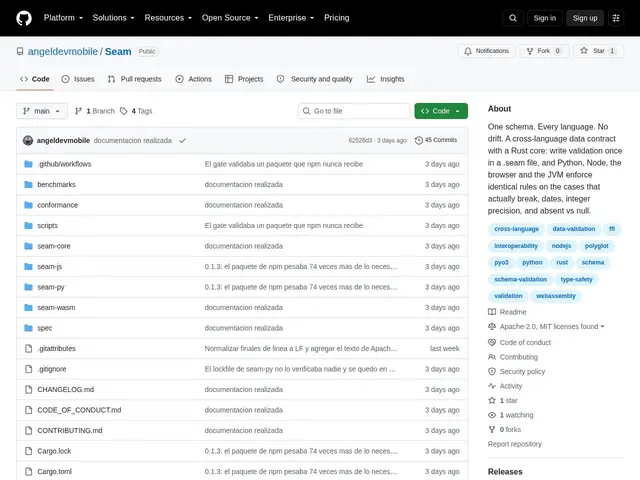
Description
When a system spans multiple languages — a Python backend, a JavaScript frontend, maybe a Rust service — a subtle and dangerous class of bug shows up: each language validates "the same" data slightly differently. JavaScript can't represent large integers precisely, Python and JSON handle null versus a missing field differently, date parsing varies by library. Usually each side writes its own validation (Zod on the frontend, Pydantic on the backend) and hopes they agree — until they don't, and bad data slips through silently.
Seam attacks this by making the schema itself the single source of truth: you write one .seam file, and Rust-compiled bindings enforce the exact same rules in Python, Node.js, the browser (via a 55 KiB WebAssembly build), and Rust itself. It handles the genuinely hard cross-language cases explicitly — 64-bit integer precision, date representation, null vs. absent fields — parses JSON itself rather than trusting each language's native parser (to avoid JavaScript's well-known integer precision loss), and generates native types per language (TypedDict for Python, TypeScript interfaces for Node). Correctness is backed by a 95-case conformance suite run identically across every binding, plus continuous fuzzing of the hand-written parsers. It's free, open source, and seam-core has zero dependencies.
💬 Our review
The short version: Seam is solving a real and specific problem — validation drift between languages — that most teams only discover after it causes a production bug, and the conformance-suite-plus-fuzzing approach to guaranteeing identical behavior across bindings is a genuinely rigorous way to earn trust in that guarantee.
Against single-language validators like Zod or Pydantic v2, which are more mature and have larger ecosystems within their own language, Seam's advantage only materializes if you actually have a polyglot boundary to protect — for a single-language codebase, adopting a cross-language schema format is pure overhead. Against protobuf-adjacent tools like protovalidate or schema languages like CUE, which solve overlapping but not identical problems (protobuf ecosystems assume you're already on protobuf; CUE is more general-purpose config validation), Seam is more narrowly focused on validation itself. Being a young project from a less established author is worth noting — the conformance suite is a good sign of engineering discipline, but production track record is still limited. Worth adopting if you're actively fighting cross-language validation bugs between a Python/Node/Rust/browser boundary; unnecessary if everything lives in one language already, where Zod or Pydantic alone is simpler.
💰 Pricing
📊 Global score
🤖 AI-enriched data
Open source, gratuit
Pros
Un seul schéma .seam validé identiquement dans 4 environnements
Gère explicitement les pièges cross-langage (entiers 64-bit, dates, null vs absent)
Suite de conformance de 95 cas + fuzzing continu
Zéro dépendance dans seam-core, build WASM léger (55 KiB)
Cons
Overhead inutile si tout le code est dans un seul langage
Projet jeune, moins de recul en production que Zod ou Pydantic
Chevauche partiellement protovalidate/CUE sans les remplacer complètement