Conecta
A single-container tool that does zero-downtime blue-green deployments on a plain VPS, using its own internal DNS and health checks instead of requiring Kubernetes.
🔗 Visit Conecta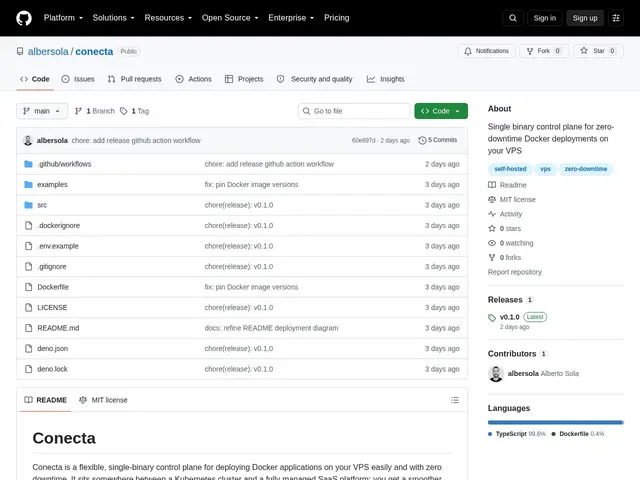
Description
Zero-downtime deployment usually means one of two things: pay for a managed platform (Heroku-style PaaS, or a cloud provider's app service), or stand up Kubernetes, which solves the problem but at the cost of running an entire orchestration cluster for what might be one or two VPS boxes. Conecta targets the gap in between — developers who self-host on a VPS and want blue-green deployments (run the new version alongside the old, switch traffic over once it's healthy, avoid downtime) without adopting Kubernetes just to get that one capability.
It ships as a single Docker image (built on Deno and the Docker CLI) that acts as a control plane: it runs HTTP health checks to confirm a new deployment is actually ready before switching, uses its own internal authoritative DNS (serving A, AAAA, and SRV records) to route traffic between blue and green versions, persists configuration in SQLite, and exposes a webhook-based API so any CI/CD system can trigger a deployment. It's explicitly designed with no vendor lock-in — bring your own registry, proxy, and TLS setup. Free and open source.
💬 Our review
The short version: Conecta's whole reason to exist is that Kubernetes is genuinely overkill for a single VPS or small fleet, but most self-hosters end up either accepting downtime on deploy or hand-rolling their own blue-green script — Conecta packages that specific capability without the orchestration overhead.
Against Kubernetes, the trade-off is honest: you give up auto-scaling, self-healing, and the broader ecosystem in exchange for something you can actually understand and run on one box. Against fully managed SaaS deployment platforms (Heroku, Render, Fly.io), you give up the managed convenience but keep full control and avoid a recurring platform fee — you're already paying for the VPS either way. The internal DNS approach for routing blue/green traffic is a clever way to avoid depending on an external load balancer, though it does mean understanding one more moving part in your stack. Being free, open source, single-binary, and vendor-agnostic (any CI/CD, registry, proxy, TLS) removes real adoption friction. Worth it if you're self-hosting Docker apps on a VPS and want zero-downtime deploys without a Kubernetes cluster; not relevant if you're already on Kubernetes or a managed PaaS that already solves this.
💰 Pricing
📊 Global score
🤖 AI-enriched data
Open source, gratuit
Pros
Déploiement blue-green zéro-downtime sans cluster Kubernetes
Image Docker unique, simple à faire tourner
Aucun vendor lock-in : CI/CD, registry, proxy, TLS libres
Gratuit et open source
Cons
Pas d'auto-scaling ni de self-healing façon Kubernetes
DNS interne = une pièce de plus à comprendre dans la stack
Pertinent seulement pour du self-hosting VPS, pas pour du cloud managé