Oconee Runtime
Enterprise policy-enforcement layer that watches what coding agents do — prompts, commands, file changes — and blocks or alerts on sensitive data exposure.
🔗 Visit Oconee Runtime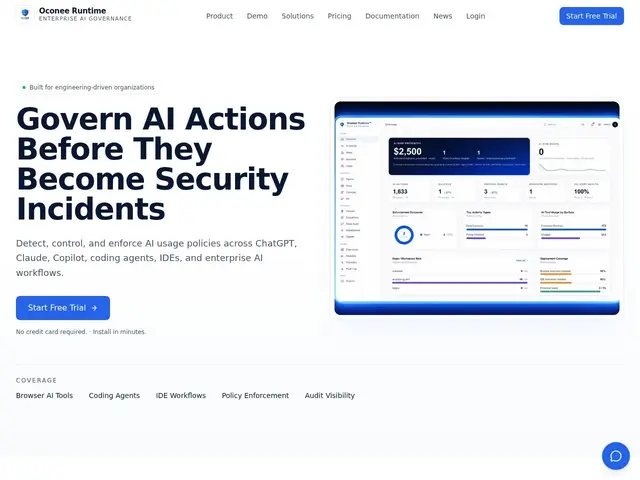
Description
Once a company lets developers use AI coding agents freely, a real question shows up: what's stopping an agent from pasting a customer's API key into a prompt, or running a destructive command nobody reviewed? Most teams currently have no visibility into this at all. Oconee Runtime is built specifically to close that gap for engineering organizations.
Oconee Runtime sits between developers' coding agents and the systems they touch, giving real-time visibility into prompts sent to AI tools, detecting sensitive data before it leaves the environment, and enforcing allow/warn/block policies on commands and file mutations. It blocks credentials from being exposed, keeps a full audit log, sends Slack alerts on policy violations, and exports to SIEM systems for security teams that already centralize logs elsewhere. SSO/SAML and GDPR compliance tooling are included at the Enterprise tier. Pricing runs from $750/month for 10 users up to $7,500/month and beyond for 250+ users, positioning it as a security-team purchase rather than a per-developer tool.
💬 Our review
The short version: Oconee Runtime is enterprise security tooling for a problem that barely existed two years ago — AI coding agents leaking secrets or running unreviewed destructive commands — and it's priced like enterprise security tooling, not a developer utility.
There's no named direct competitor yet in the facts gathered, which fits: dedicated "AI agent governance" as a standalone enterprise product category is still forming, with most current solutions being ad-hoc internal scripts or generic DLP (data loss prevention) tools not built for agent-specific behaviors like prompt content or file-mutation patterns. The SIEM export and SSO/SAML support signal this is built to slot into an existing security stack rather than replace it. At $750–7,500+/month, this is squarely for organizations with a security or compliance team large enough to justify a dedicated line item — a five-person startup letting engineers use Cursor or Claude Code has no realistic use for this. Worth serious evaluation for regulated or enterprise engineering orgs adopting AI coding agents at scale; not relevant for small teams or individual developers.
💰 Pricing
📊 Global score
🤖 AI-enriched data
750$/mois (10 users) à 7500$/mois+ (250 users), utilisateurs additionnels 30-50$
Pros
Visibilité temps réel sur les prompts envoyés aux agents IA
Détection et blocage de données sensibles/credentials
Export SIEM, SSO/SAML, conformité RGPD
Politiques allow/warn/block sur commandes et fichiers
Cons
Prix enterprise (750-7500$+/mois), hors de portée des petites équipes
Catégorie de produit encore jeune, pas de concurrent direct établi
Pertinent seulement pour organisations avec fonction sécurité/conformité dédiée