Jern Cloud
A policy-bound cloud coding agent that works on isolated, pinned environments and delivers changes as pull requests, with an encrypted audit trail.
🔗 Visit Jern Cloud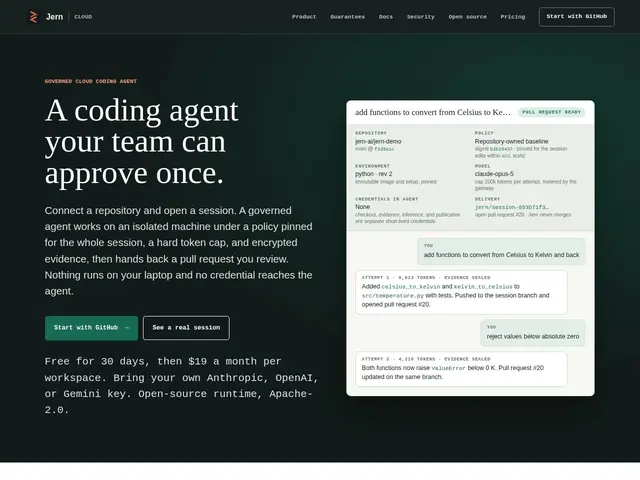
Description
Cloud coding agents like Devin or Cursor's cloud agents can now go off and write code autonomously, but handing an AI agent broad access to a codebase and infrastructure makes security teams nervous — what exactly did it touch, and under what rules? Jern Cloud is built around answering that question by design: every agent run happens inside a locked-down environment governed by a policy file that lives in your own repository.
Jern Cloud runs a coding agent on an isolated machine per session, with the policy it operates under pinned by cryptographic digest and enforced before any action executes — so the rules can't drift mid-run. It stores no long-lived credentials in the agent itself, using short-lived, scoped credentials for each operation instead, caps token usage hard through a provider gateway, and encrypts a full evidence trail of every attempt with AES-256-GCM. Work comes back as a pull request on an isolated branch for human review, never a direct commit. The runtime itself is open source; the hosted service costs $19/month per workspace after a 30-day trial, and you bring your own Anthropic, OpenAI, or Gemini API key.
💬 Our review
The short version: Jern Cloud's entire pitch is auditability and containment — a policy pinned by digest, short-lived credentials, and an encrypted evidence trail are the kind of controls a security team would ask for after the first incident with an unsupervised coding agent, built in from day one instead of bolted on after.
Against Devin and Cursor Cloud Agents, which emphasize autonomy and speed, Jern trades some of that for governance: the policy-pinning and evidence trail mean you can actually answer "what did the agent do and under what rules" after the fact, which those competitors don't foreground as strongly. The open-source runtime is a meaningful trust signal — you can inspect how policy enforcement actually works rather than taking a vendor's word for it. The trade-off is that bring-your-own-API-key pricing means your real cost scales with usage on top of the $19/month workspace fee, and a young platform means less real-world hardening than Devin's larger deployment base. Worth adopting if your organization needs to justify AI-assisted coding to a security or compliance function; overkill if you just want the fastest autonomous agent with no governance overhead.
💰 Pricing
📊 Global score
🤖 AI-enriched data
19$/mois par workspace après essai 30 jours, clé API perso requise (Anthropic/OpenAI/Gemini)
Pros
Politique épinglée par digest cryptographique, appliquée avant exécution
Aucune credential longue durée stockée dans l'agent
Piste d'audit chiffrée (AES-256-GCM) de chaque tentative
Runtime open source, livraison en PR isolée jamais en commit direct
Cons
Coût réel = 19$/mois + votre propre facturation API (Anthropic/OpenAI/Gemini)
Plateforme jeune, moins de recul que Devin
Gouvernance ajoute de la friction vs l'autonomie pure de Devin/Cursor