Duckle
Open-source ETL platform that builds data pipelines visually or in code and runs them on DuckDB, with no vendor lock-in.
🔗 Visit Duckle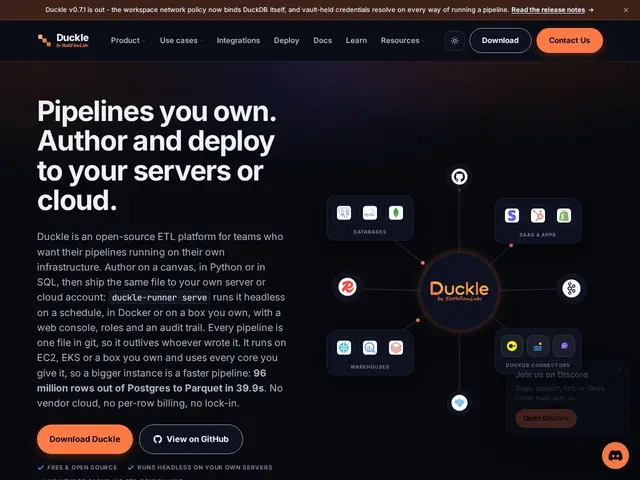
Description
Every company that pulls data from several places — a payments provider, a CRM, a warehouse — ends up needing something to move and reshape that data automatically, on a schedule, without someone copy-pasting spreadsheets. That's what an ETL tool does: it Extracts data from a source, Transforms it into the shape you need, and Loads it somewhere useful. Duckle is one of these tools, built to be run on your own infrastructure instead of a vendor's cloud.
Duckle is an open-source ETL platform where pipelines can be built on a visual drag-and-drop canvas (385 components) or written directly in code, then compiled automatically to SQL and executed on DuckDB, a fast embedded analytical database. It ships with 188+ connectors to common databases, warehouses, SaaS tools and storage backends, an integrated dbt step for transformation-layer teams, and an MCP server so AI agents can trigger or inspect pipelines. A local AI assistant ('Duckie') can also generate pipelines from a natural-language description. It's dual-licensed MIT/Apache-2.0, self-hosted, and sends no telemetry — squarely aimed at teams that need data sovereignty and want to avoid recurring per-row pricing.
💬 Our review
The short version: if your team already runs infrastructure and wants ETL without paying Fivetran-style per-connector, per-row fees, Duckle is a serious open-source contender — as long as you're comfortable self-hosting and running DuckDB as the execution engine.
The honest trade-off is maturity versus control. Fivetran and Airbyte have years of connector hardening, managed infrastructure, and enterprise support contracts; Duckle asks you to run and maintain the platform yourself in exchange for zero licensing cost and full data sovereignty (no data ever leaves your infrastructure). The DuckDB execution model is a genuine differentiator — it's fast for analytical workloads and avoids spinning up a separate warehouse just to transform data — but it also means Duckle inherits DuckDB's single-node scaling profile rather than a distributed engine's. The dbt integration and MCP server are forward-looking touches that suggest active development. Worth adopting if compliance or cost is forcing you off managed ETL; not worth it if you have no in-house ops capacity to run it.
💰 Pricing
📊 Global score
🤖 AI-enriched data
Dual-licence MIT ou Apache-2.0, auto-hébergé, aucun coût de licence
Pros
Gratuit et auto-hébergé, zéro coût par ligne ou par connecteur
188+ connecteurs et compilation automatique en SQL sur DuckDB
Assistant IA local (Duckie) pour générer des pipelines
Zéro télémétrie, souveraineté totale des données
Cons
Moins mature que Fivetran/Airbyte (support, hardening des connecteurs)
Exécution mono-nœud via DuckDB, pas de moteur distribué
Demande une capacité ops interne pour l'auto-hébergement