Cartapel
Open-source tool that generates a Django-admin-style control panel for an existing database in about a minute, config-as-code via HCL.
🔗 Visit Cartapel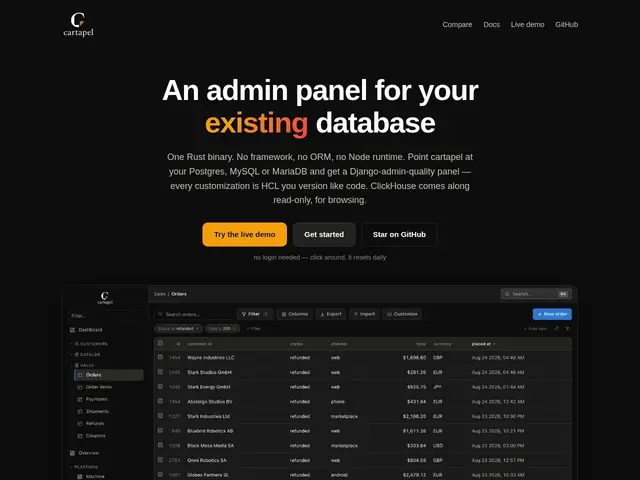
Description
If you've ever used Django, you know the built-in admin panel: point it at your data models and you instantly get a working interface to browse, edit, and manage records — no separate app to build. Most other backend stacks don't have that shortcut, so teams either build a custom admin UI from scratch or wire up a general dashboard tool. Cartapel brings that Django-style instant admin panel to databases outside the Django ecosystem.
Cartapel connects to an existing PostgreSQL, MySQL, MariaDB, or ClickHouse database and generates a full admin interface — foreign key relations rendered automatically, SQL dashboards with stat tiles and charts, row-level and column-level permissions, and complete audit logs showing before/after diffs on every change. Configuration is code-first via HCL files (with a visual editor that can export back to HCL), it supports internationalization, and setup is designed to take about a minute via Docker. It's free and open source under MIT, positioning itself against both dedicated admin generators (Django admin itself) and general-purpose internal-tool builders like Retool, Metabase, NocoDB, Baserow, and Directus.
💬 Our review
The short version: if you want a Django-admin-caliber control panel for a database that isn't running Django, and you don't want to pay Retool's per-seat pricing to get one, Cartapel is a strong, free, open-source pick — as long as HCL-as-config doesn't scare off your team.
The config-as-code approach is the main differentiator from Retool, Metabase, or NocoDB, all of which lean toward visual/drag-and-drop configuration stored in their own platform. HCL means your admin panel definition lives in version control alongside your code, which teams that already use Terraform will find familiar and teams that don't may find like unnecessary friction (the visual editor with HCL export is the bridge for that). Row/column permissions and full audit logging with diffs are genuinely enterprise-grade features to get for free — that's usually a paid-tier feature on hosted competitors. Being free and self-hosted means no per-seat costs scaling with team size, unlike Retool. Worth it for teams comfortable with Docker and version-controlled config; less appealing if you want a purely visual, no-code experience.
💰 Pricing
📊 Global score
🤖 AI-enriched data
MIT, auto-hébergé, aucun coût par siège
Pros
Gratuit et open source (MIT), pas de coût par siège
Permissions ligne/colonne + audit log complet avec diffs
Config-as-code (HCL) versionnable avec le reste du code
Setup Docker en ~1 minute, multi-bases (Postgres/MySQL/MariaDB/ClickHouse)
Cons
HCL-as-config peut rebuter une équipe qui veut du 100% visuel
Moins connu/éprouvé que Retool ou Metabase
Communauté et écosystème de plugins encore restreints