FULCRUMAXE
An autonomous multi-agent software team that runs inside your GitHub/GitLab repo, turning Discussions into merged, reviewed PRs with no human intervention.
🔗 Visit FULCRUMAXE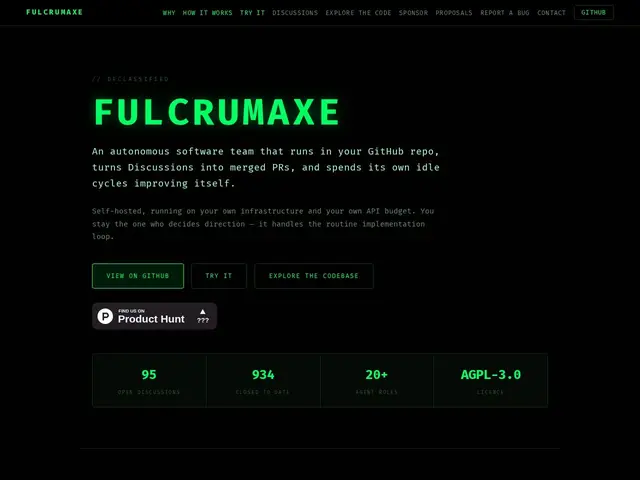
Description
AI coding agents can already write a pull request from a prompt, but most setups still need a human to kick off each task, review the result, and decide when it's safe to merge. FULCRUMAXE tries to remove that human loop entirely: you post a Discussion describing what you want, and a coordinated team of AI agents turns it into a spec, then a pull request, then — if it passes review — a merge, without anyone clicking approve.
It runs self-hosted, on your own infrastructure and your own LLM API budget, and coordinates 26 distinct agent roles (Executor, code-reviewer, security-reviewer, project-manager, acceptance-tester, and others) through GitHub's native Discussions/Issues/PRs — the same primitives a human team already uses. Every PR goes through code review, and anything touching authentication, secrets, or sandboxed code additionally requires a mandatory security review before it can merge. Agents work in isolated git worktrees with permission hooks to prevent unauthorized writes, and when there's nothing left in the queue, the system scans its own codebase, files its own Discussions, and ships fixes to itself through that same pipeline. It's installable as a Claude Code plugin and also works with Codex CLI, Kiro CLI and other agent CLIs. The creator reports running it inside a real repo for five months, merging 1,135 PRs.
💬 Our review
The short version: FULCRUMAXE is a bet that a coordinated team of specialized AI agents, with mandatory review gates, can run an entire GitHub repo's development loop — from idea to merged PR — with no human in the middle, and the 1,135-PR track record is the main evidence it's not just a demo.
Against fully autonomous coding agents like Devin, OpenHands or SWE-agent, FULCRUMAXE's distinguishing bet is process over raw model capability: instead of one agent doing everything, it splits the work across 26 roles with an enforced code-review-then-security-review gate before anything merges, which should catch more mistakes than a single agent self-approving its own work. That said, the creator's own account is candid that model-to-model review is good at surface-level issues but weaker on deep bugs like race conditions — the review layer reduces risk, it doesn't eliminate the need for a human to eventually look at what's shipping. It's free to run since it's self-hosted (you cover your own API costs), but setup and ongoing infrastructure management aren't trivial, and there's a real risk of agents satisfying the letter of a Discussion while missing what you actually meant. Worth trying if you already trust agentic coding tools and want a structured, reviewed pipeline instead of ad-hoc prompting; not a fit if you need a human sign-off on every merge or don't want to manage the self-hosted infrastructure and API spend it requires.
💰 Pricing
📊 Global score
🤖 AI-enriched data
Gratuit en self-hosted, coûts d'API LLM à la charge de l'utilisateur
Pros
Gratuit et self-hosted, contrôle total sur l'infrastructure et le budget API
Pipeline de revue multi-rôles (revue de code + revue sécurité obligatoire) avant tout merge
Auto-amélioration : détecte et corrige ses propres bugs quand la file est vide
Historique d'usage réel cité (1 135 PR mergées en 5 mois)
Cons
Revue modèle-à-modèle plus faible sur les bugs profonds (race conditions, off-by-one) selon le créateur lui-même
Mise en place et gestion d'infrastructure self-hosted non triviales
Risque que les agents satisfassent la lettre d'une demande sans en saisir l'intention réelle
Page d'accueil derrière un checkpoint anti-bot Vercel, vérification directe du contenu limitée cette session