Aftersight
Observability for self-improving AI agents that writes execution telemetry as plain readable files inside the repository itself, so agents can read their own history with normal file tools.
🔗 Visit Aftersight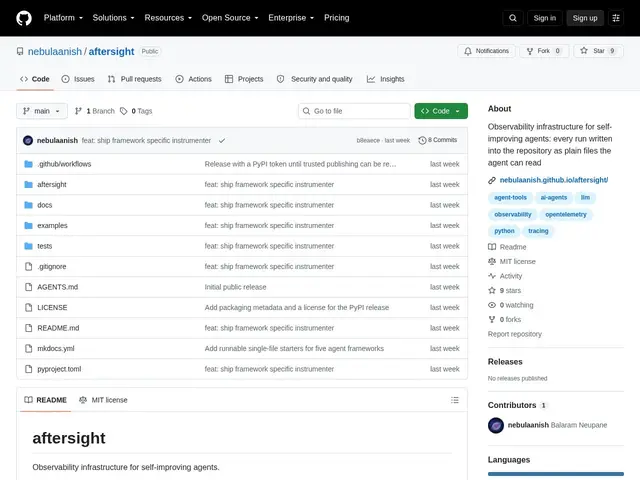
Description
AI coding agents that are supposed to "learn" from their own mistakes need some kind of memory of what actually happened during past runs — but most observability tools store that history on someone else's server, behind a login. Aftersight keeps that history as plain files sitting right inside your own project folder, so the agent, and you, can just read them like any other file.
Aftersight is a Python library that captures agent execution telemetry — logs, traces, outlines, analytics — and writes it as human- and agent-readable files directly into the repository, with NAVIGATE.md files for orientation. It's OpenTelemetry-compatible, ships automatic instrumentors for frameworks like the OpenAI Agents SDK, and offers a decorator-based API for manual instrumentation. It works entirely locally — no network calls, no credentials — and redacts sensitive payloads by default. MIT licensed, installs with one pip command.
💬 Our review
The short version: Aftersight bets that the simplest, most robust memory for a self-improving agent is a plain text file in the repo it's already working in, not another dashboard to log into.
Against LangSmith or Langfuse, which centralize traces on a hosted (or self-hosted but still separate) platform, Aftersight's repo-native files mean the agent itself can read its own history with the same tools it uses to read code — a genuine advantage for self-improving agent loops specifically. The trade-off is real: local files don't give you a team-wide dashboard, alerting, or the managed eval workflows LangSmith/Langfuse specialize in, and they won't scale cleanly to large multi-agent deployments. Free and open source, worth adopting if you're building an agent that needs to reference its own past runs; skip it if you need a shared team observability dashboard, where LangSmith or Langfuse fit better.
💰 Pricing
📊 Global score
🤖 AI-enriched data
Gratuit, licence MIT
Pros
Historique stocké en fichiers lisibles directement dans le dépôt
Aucun appel réseau ni identifiant requis, tout est local
Compatible OpenTelemetry, rédaction des données sensibles par défaut
Cons
Pas de tableau de bord d'équipe centralisé
Pas adapté à de gros déploiements multi-agents
Pas de workflows d'évaluation managés comme LangSmith/Langfuse