Cairn
An open-source incident-analysis copilot: ask it in plain English why something broke, and it queries your observability stack, correlates deploys, and proposes a root cause with evidence, with human approval required before it acts.
🔗 Visit Cairn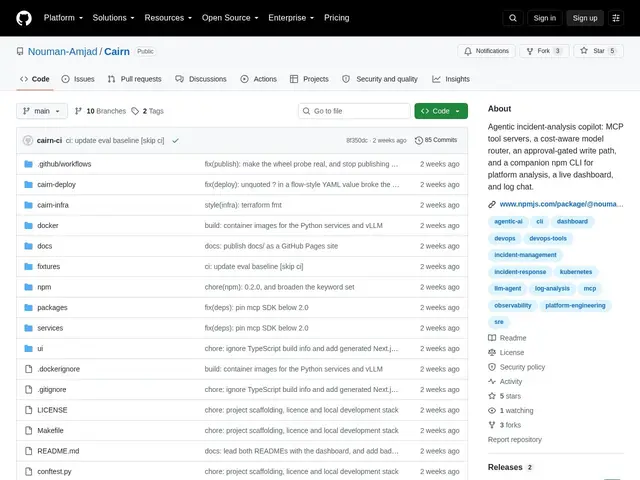
Description
When something breaks at 3am, the person on call usually has to manually dig through several different monitoring tools just to piece together what happened before they can even start fixing it. Cairn lets you just ask, in plain English, "why did checkout latency spike at 3am?" — it does the digging across your monitoring tools itself and proposes a cause with evidence, but it's built to never take any risky action without a human clicking approve first.
Cairn is an open-source (Apache 2.0) incident-analysis copilot where every backend capability is exposed as an MCP tool. It routes inference through a cost-and-sensitivity-aware model router that splits work between a local 8B model and frontier models, and enforces a durable, database-triggered, append-only audit log so write actions can never happen without an approval step. The stack is Python plus a Next.js dashboard plus Terraform IaC plus OPA policy guardrails, backed by 246 passing tests against PostgreSQL 16/pgvector and a 30-scenario evaluation harness with ground-truth causes. Self-hosted, with companion repos for Helm/ArgoCD deployment and Terraform infra (VPC/EKS/RDS).
💬 Our review
The short version: Cairn's real pitch isn't the AI part, it's the guardrails around it — an approval state machine and audit trail that make "let an AI investigate incidents" something a security-conscious team could actually sign off on.
Most agentic incident tools focus on capability (what can it investigate); Cairn spends just as much effort on constraint (what can it never do without approval), with a state machine that's independently tested for no-self-approval and no-double-execution. That rigor comes with real infrastructure weight: PostgreSQL, Redis, MinIO, OPA and Kubernetes are all expected, plus an optional GPU for local model serving. It's also very young, single-digit GitHub stars, with self-reported "not yet verified" eval accuracy. Worth piloting if you already run a Kubernetes-based observability stack and want a governed AI copilot for incident response; skip it if you want something lighter-weight or don't yet have that infrastructure, since setup cost alone will dominate.
💰 Pricing
📊 Global score
🤖 AI-enriched data
Logiciel gratuit (Apache 2.0), coûts d'infra (Postgres/Redis/MinIO/OPA/Kubernetes + LLM optionnel) à la charge de l'utilisateur
Pros
Portes d'approbation humaine obligatoires avant toute action d'écriture
Routage des coûts entre modèle local et modèles frontière selon la sensibilité
Tests et documentation exceptionnellement complets pour un projet jeune (246 tests, 14 ADR)
Cons
Communauté très restreinte, précision réelle en production non encore vérifiée
Exigences d'infrastructure lourdes (Postgres, Redis, MinIO, OPA, Kubernetes)
Auto-hébergé uniquement, pas d'offre SaaS managée