FaultLens
A local-first, offline log analysis tool written in Go that turns raw application logs into structured incident diagnoses with evidence-based root-cause hypotheses.
🔗 Visit FaultLens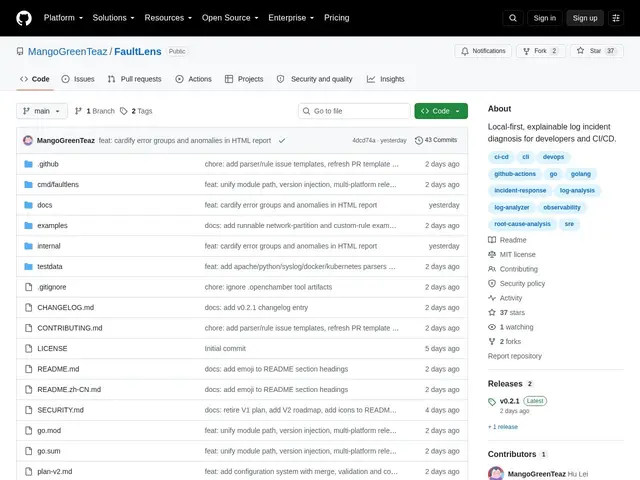
Description
When something breaks in production, the raw evidence is usually a giant wall of log text that nobody wants to read line by line at 3am. FaultLens reads that wall of text for you and hands back a plain-English diagnosis — "this looks like a database timeout, here's the evidence" — without ever sending your logs to a company's server.
FaultLens is a Go CLI that parses 9 common log formats (JSON, Nginx, Apache, Spring Boot, Syslog, Docker, Kubernetes, Python, plain text) and matches them against 14 built-in diagnosis rules for the usual suspects — DB failures, Redis issues, OOM, timeouts, HTTP errors — using SHA-256 fingerprint clustering and explainable z-score anomaly detection instead of a black-box model. It runs fully offline with a tiny memory footprint (about 2MB heap for 500MiB of logs), outputs to terminal/JSON/Markdown/HTML, and plugs into CI via a GitHub Actions composite action. MIT licensed.
💬 Our review
The short version: FaultLens is what you'd build if you wanted "grep -i error" to actually explain itself, using statistics you can audit rather than an LLM you have to trust.
Compared to sending logs to a cloud APM like Datadog or New Relic, FaultLens never leaves your machine and needs no subscription, which matters for cost-sensitive teams or logs that can't leave your infrastructure — the trade-off is it's CLI-only, single-machine, and won't aggregate logs across a fleet like a real observability platform does. It's free and open-source (MIT); worth adding to a CI pipeline or an on-call runbook right now if log triage eats time; skip it if you need multi-server aggregation or a GUI, where Datadog or New Relic remain the better fit.
💰 Pricing
📊 Global score
🤖 AI-enriched data
Gratuit, licence MIT
Pros
Fonctionne entièrement hors ligne, aucune télémétrie
Détection d'anomalies explicable (z-score) plutôt que boîte noire
Empreinte mémoire minimale même sur de gros fichiers de logs
Cons
CLI uniquement, pas d'interface graphique
Analyse limitée à une seule machine, pas d'agrégation multi-serveurs
Communauté encore restreinte