Jardinero
A self-hosted, autonomous AI engineer that watches production logs, turns Linear tickets into pull requests, and manages PR review cycles inside isolated sandboxes.
🔗 Visit Jardinero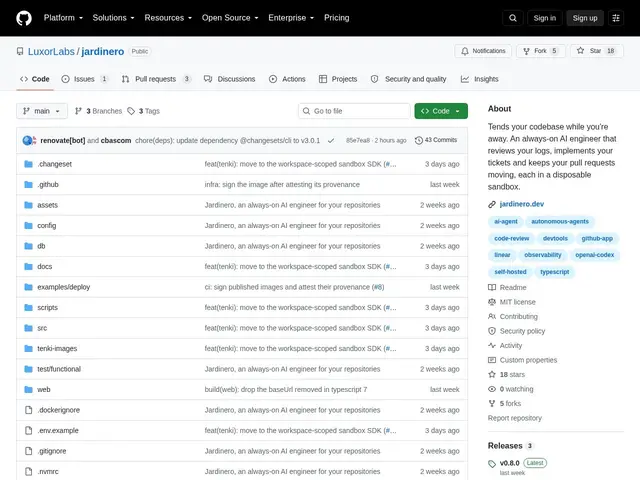
Description
Keeping a codebase healthy means constantly watching for errors in production, turning tickets into actual code, and following up on pull request reviews — busywork that eats a developer's day. Jardinero is a self-hosted AI "gardener" that does that upkeep on its own: it watches your logs for problems, turns your Linear tickets into pull requests, and handles PR review comments, all inside a sandboxed environment you control.
Jardinero is a Node.js 24 / SQLite application built around a state-machine workflow engine. It monitors production logs through Grafana/Loki and auto-fixes issues it's confident about, converts Linear ticket assignments into tested pull requests, and resolves CI failures or review comments on open PRs. Code execution happens in an external sandbox VM provider (Tenki or Freestyle), and it uses OpenAI Codex/ChatGPT for generation. It's controllable from Discord, Linear, GitHub or its own web dashboard, self-hosted under MIT license — but it needs persistent hosting (about 1GB RAM), a public HTTPS URL and a GitHub App install to run.
💬 Our review
The short version: Jardinero is one of the more complete attempts at an "always-on junior engineer" — it doesn't just write code from tickets, it also watches production logs and manages the PR review loop, end to end.
Compared to narrower coding-agent tools that only turn a ticket into a PR, Jardinero's log-monitoring and PR-review-response loop close more of the maintenance cycle — but that also means more moving parts: a sandbox VM provider account, Grafana/Loki already running, persistent server hosting, and OpenAI Codex token spend all need to be in place before it does anything useful. Free and open-source (MIT) to run, but not free to operate — you're paying for infrastructure and tokens either way. Worth setting up if you already have the Grafana/Loki plus Kubernetes stack it expects and want autonomous ticket-to-PR handling; skip it if you're a small team without that observability stack already in place, since setup cost will exceed the time it saves.
💰 Pricing
📊 Global score
🤖 AI-enriched data
Logiciel gratuit (MIT), coûts d'infra (VM sandbox + tokens OpenAI + hébergement) à la charge de l'utilisateur
Pros
Boucle complète : logs vers correctif, ticket vers PR, revue vers résolution CI
Auto-hébergé, aucun verrouillage fournisseur
Intégrations riches : GitHub, Linear, Discord, Grafana
Cons
Mise en place lourde (Grafana/Loki, fournisseur sandbox, hébergement persistant)
Coût variable lié à la consommation de tokens et de VM
Projet jeune, petite communauté