OpenHive
An open-source framework where a lead "Queen" AI agent spawns and coordinates worker agents on its own, with built-in crash recovery, cost limits, and human approval steps.
🔗 Visit OpenHive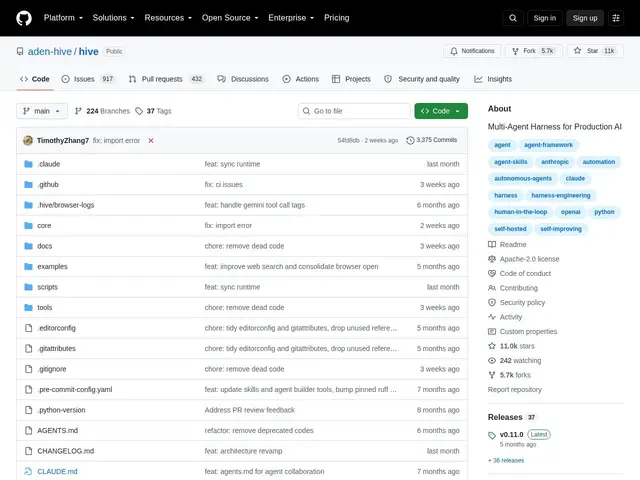
Description
Most multi-agent frameworks make you manually draw the workflow: which agent does what, in what order, with what handoffs. OpenHive flips that around — a persistent "Queen" agent acts as coordinator and spawns worker agents as needed to parallelize a task, without a developer having to pre-wire the whole graph, and the system is built to survive crashes and keep a human in the loop for anything risky.
Built by the team behind Aden after four years automating ERP/accounting workflows for construction companies, OpenHive tracks task state through a shared ledger instead of passing data buffers between agents, supports crash-safe "park and resume" so a run doesn't restart from scratch after a failure, and enforces cost/budget controls to stop runaway spend. It has an out-of-band human-in-the-loop feature ("Sentinel") that can pipe approval requests to Slack or Telegram, is model-agnostic (OpenAI, Anthropic, Google, DeepSeek, Ollama), and includes MCP integration for 100+ tools plus browser automation. It's Apache 2.0-licensed, Python 3.11+ only for now (a JS/TS SDK is on the roadmap), and some parts of its dashboard reportedly had loading errors during evaluation.
💬 Our review
The short version: OpenHive is aimed squarely at a real, underserved problem — getting multi-agent systems to survive production, not just demo well — with genuinely production-minded features (crash recovery, cost caps, human approval) that a lot of flashier agent frameworks skip.
Against LangGraph or CrewAI, which require you to explicitly define the agent graph/workflow up front, OpenHive's dynamic worker-spawning under a coordinating "Queen" agent is a genuinely different model — less upfront design, more runtime flexibility — which is either liberating or harder to reason about depending on how deterministic you need your pipeline to be. Its focus on crash-safe state and budget enforcement addresses a common complaint about agent frameworks in production (silent cost blowups, lost work on failure) that many competitors treat as an afterthought. It's free and open-source (Apache 2.0), Python-only today, and young enough that its dashboard had rough edges during evaluation. Worth a serious look if you're moving agents from prototype to production and specifically need cost control and crash recovery; look at LangGraph or CrewAI instead if you want more explicit control over the exact workflow graph.
💰 Pricing
📊 Global score
🤖 AI-enriched data
Gratuit, licence Apache 2.0
Pros
Coordination dynamique (agent 'Queen' qui spawn des workers) sans graphe de workflow à dessiner à la main
Reprise après crash sans repartir de zéro ('park and resume') via un ledger partagé
Contrôle des coûts et des budgets intégré, contrairement à beaucoup de frameworks concurrents
Validation humaine hors-bande via Slack/Telegram, agnostique au fournisseur de modèle
Cons
Python uniquement pour l'instant, SDK JS/TS encore au stade de roadmap
Modèle de coordination dynamique moins prévisible qu'un graphe de workflow explicite
Dashboard ayant présenté des erreurs de chargement lors de l'évaluation