KokoClone
An open-source tool that clones a voice from a 3-10 second audio clip and uses it to generate speech in 8 languages, running on a laptop CPU or a GPU.
🔗 Visit KokoClone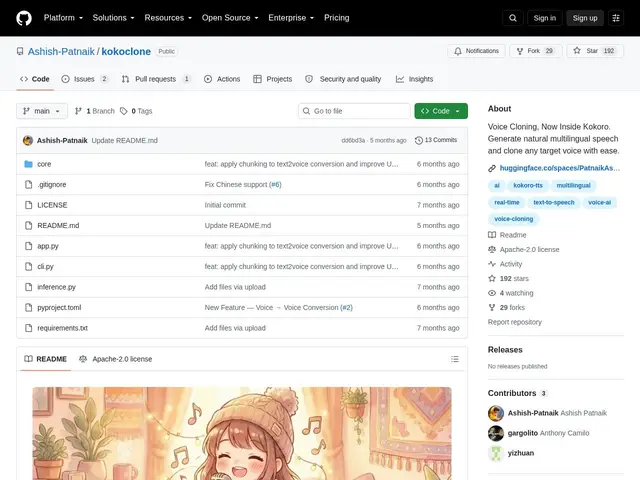
Description
Convincing voice cloning used to require either a paid API and an account, or a research-grade model that only ran on a beefy GPU. KokoClone packages a real zero-shot voice-cloning pipeline as a free, open-source tool: give it a short voice sample (3-10 seconds) and some text, and it generates speech in that voice — no training, no per-minute billing, and it'll run on a Mac or laptop as well as an NVIDIA GPU.
Built on Kokoro-ONNX for the base TTS model and a component called Kanade for voice conversion, KokoClone supports zero-shot cloning and text-to-cloned-speech in 8 languages (English, Hindi, French, Japanese, Chinese, Italian, Portuguese, Spanish), plus direct audio-to-audio voice conversion without needing a transcript. It handles long audio via VRAM-aware chunking (capped around 8.9 seconds per segment) and ships a Gradio web UI, a CLI, and a Python API, with a live demo hosted on Hugging Face Spaces. It's Apache-2.0 licensed with 192 GitHub stars, and its positional embeddings are precomputed for roughly 1,024 mel frames, a technical ceiling on how it chunks longer inputs.
💬 Our review
The short version: KokoClone is a strong, free alternative to paid voice-cloning APIs for anyone comfortable running a script or a Gradio UI locally, with real multilingual support (8 languages) and decent GitHub traction (192 stars) backing it up.
Against commercial voice-cloning services (ElevenLabs and similar), KokoClone trades a polished dashboard and subscription billing for zero cost and full local control over your voice data — a meaningful privacy plus if you're cloning someone's actual voice. Against other open-source TTS/cloning repos in the same wave (vits-evo, Kitten TTS), KokoClone's edge is genuine multilingual support (8 languages) and a ready-made Hugging Face demo, at the cost of needing a slightly heavier setup (PyTorch + ONNX) than the smallest single-purpose models. Worth it for developers who want real voice cloning without a subscription and don't mind running it themselves; a paid API is still simpler if you want a one-line integration with no local setup at all.
💰 Pricing
📊 Global score
🤖 AI-enriched data
Gratuit, licence Apache 2.0
Pros
Clonage vocal zero-shot à partir de 3-10 secondes d'audio seulement
8 langues supportées (EN, HI, FR, JA, ZH, IT, PT, ES)
Fonctionne sur CPU (Mac/laptop) ou GPU NVIDIA, pas besoin d'infrastructure lourde
Démo en ligne prête à l'emploi sur Hugging Face Spaces
Cons
Segments audio plafonnés à ~8.9 secondes par chunk (limite technique des embeddings positionnels)
Nécessite un setup local (PyTorch + ONNX) plus lourd que les plus petits modèles TTS
Projet encore jeune (192 étoiles), pas de support commercial