Lucid
A free browser tool that lets you watch, layer by layer, which concepts a language model is "thinking about" before it writes its answer.
🔗 Visit Lucid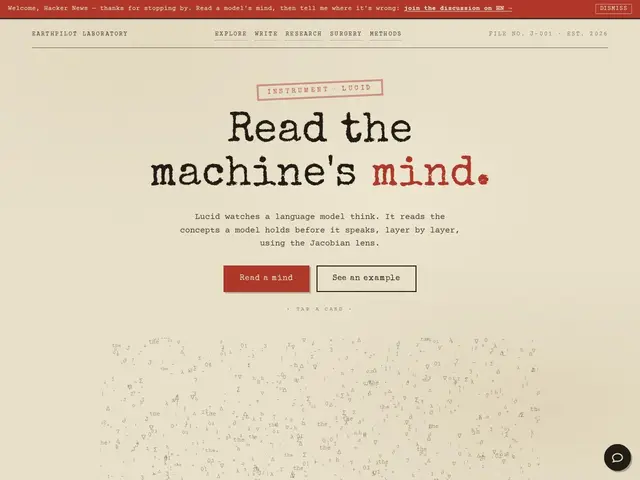
Description
Large language models produce an answer, but almost nothing about *how* they got there is visible to the person typing the prompt. Lucid is a small research instrument that opens that black box a little: type a prompt, and it shows you which internal concepts the model is holding onto, layer by layer, before it ever writes a word — including concepts it seems to consider but never actually mentions in its reply.
Lucid implements Anthropic's "Jacobian lens" technique for reading a small set of internal representations researchers call "J-space," which behaves similarly to what cognitive scientists call the brain's global workspace. It runs against small open models (Qwen 0.5B-3B, Pythia 1.4B, more on request), fits the lens once per model, and reads it with a single additional forward pass per prompt — showing top concepts per layer and position, with rank tracking for specific tokens you pin. It uses a Zener-card-style visual test (the classic symbols used in historical mind-reading experiments) as its demo interface, and every session can be exported as a shareable page. It's a free, no-signup, no-install research tool built by a solo developer (Anthony David Adams / Earthpilot), not a commercial product, and it only supports small open models rather than the frontier models most people actually use day to day.
💬 Our review
The short version: Lucid is a genuinely clever, free interpretability toy — not a product with a roadmap or support, but a well-executed public demo of real mechanistic-interpretability research that's fun and informative to poke at for ten minutes.
Against academic interpretability tools (TransformerLens, Neuronpedia), which require you to run code locally and have a research background to use, Lucid's advantage is pure accessibility: no account, no install, a browser tab and a prompt is all you need. Against reading Anthropic's own research papers on the Jacobian lens / J-space, Lucid lets you *interact* with the technique on real (if small) models instead of just reading about it. The obvious limits are that it only supports small open models (Qwen up to 3B, Pythia 1.4B) — you can't point it at GPT-4-class models — and it's a one-person research project with no guarantee of staying online or being maintained. Worth a visit if you're curious about AI interpretability and want a hands-on intuition for what "the model is thinking" could even mean; not a tool to build a workflow around.
💰 Pricing
📊 Global score
🤖 AI-enriched data
Entièrement gratuit, sans compte ni installation (outil de recherche, pas un produit commercial)
Pros
Aucune installation ni compte requis, accessible directement dans le navigateur
Implémente une vraie technique de recherche (Jacobian lens / J-space d'Anthropic), pas une simulation
Interface soignée et pédagogique (cartes de Zener) pour un sujet technique difficile
Sessions exportables et partageables
Cons
Ne fonctionne que sur de petits modèles ouverts (Qwen jusqu'à 3B, Pythia 1.4B), pas les modèles de pointe
Projet de recherche solo, aucune garantie de maintien en ligne ni de support
Pas un outil de production ou de workflow, purement exploratoire