Lanes
A platform that centralizes AI-agent access to 100+ third-party accounts (Gmail, Slack, GitHub, Notion...) behind one self-hostable, permissioned MCP layer, plus a dev environment for running several coding agents in parallel.
🔗 Visit Lanes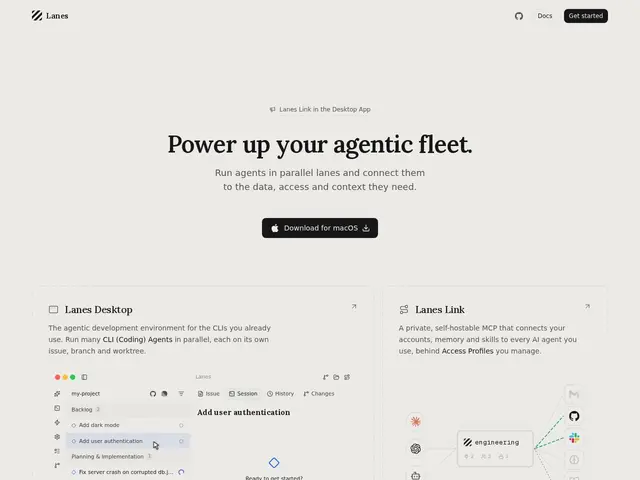
Description
If you use an AI assistant like Claude or ChatGPT and want it to actually read your email, check your Slack, or update a ticket in Linear — not just talk about doing it — someone has to wire up that connection safely, with permissions, for every single app. Lanes is a platform built to do exactly that wiring once, so any AI agent you use can plug into the same set of connected accounts instead of you configuring access from scratch every time.
Lanes' core component, Lanes Link, is a self-hostable MCP (Model Context Protocol) server that centralizes access to 100+ third-party providers (Gmail, Slack, GitHub, Notion, Linear, Stripe, and more) for AI agents, managing credentials, memory, tasks and skills through configurable Access Profiles with granular permission scoping and audit logging. A companion product, Lanes Desktop, is a development environment for running multiple coding agents in parallel across separate workspaces ('lanes'). The platform surfaced twice on Hacker News via different use-case demos — one about giving a single agent your personal context, the other about running a fleet of agents in parallel — both pointing back to the same underlying product.
💬 Our review
The short version: if you're already juggling API keys and OAuth scopes to give multiple AI agents access to the same set of tools, Lanes Link's centralized, self-hostable connection layer solves a real and growing pain point — but it's a young, multi-component platform, so expect some setup work and a less legible single value-prop than a narrower competitor.
Compared to memory-focused libraries like mem0 or Letta (MemGPT), which solve persistent agent memory specifically, Lanes is broader: it bundles memory alongside third-party account access and permissioning, which matters if your actual bottleneck is credential sprawl across a growing number of connected agents rather than memory alone. The self-hostable, open-source core (Lanes Link) avoids the vendor lock-in of building this yourself against each provider's API one at a time — the tradeoff is you're responsible for hosting and maintaining it. Worth it if you're running more than one AI agent against the same accounts and want one governed access layer instead of duplicated credentials everywhere; overkill if you only use a single agent with a couple of integrations, where each tool's native connector will do.
💰 Pricing
📊 Global score
🤖 AI-enriched data
Lanes Link (coeur MCP) gratuit et open source/self-hostable ; tarification de Lanes Desktop et des services hébergés non entièrement publiée
Pros
100+ intégrations tierces préconfigurées pour l'accès agent
Contrôle d'accès granulaire via Access Profiles + audit logging
Coeur self-hostable et open source, pas de vendor lock-in
Supporte plusieurs agents concurrents partageant les mêmes connexions
Cons
Nécessite du self-hosting/setup pour le modèle complet de contrôle d'accès
Écosystème plus petit que les acteurs établis de la mémoire d'agents
Surface produit répartie sur plusieurs composants nommés (Link, Desktop, MCP), moins lisible en une visite