Yulin AWS Simulator
An in-process AWS simulator for Node.js that fakes 40+ AWS services locally, so tests run instantly without containers or a real AWS account.
🔗 Visit Yulin AWS Simulator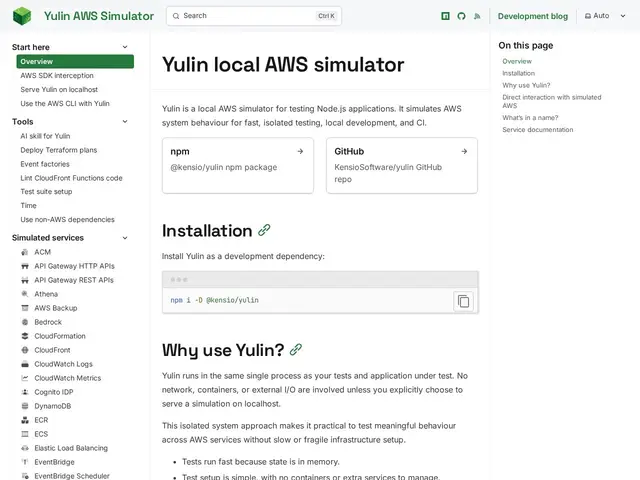
Description
When you're building an app that talks to Amazon Web Services — storing files, running background jobs, sending events between services — testing that code usually means either connecting to a real (and billable) AWS account, or spinning up heavy Docker containers that pretend to be AWS locally. Yulin offers a third option: a fake AWS that lives inside your own test process, starts instantly, and costs nothing to run.
Yulin is an in-process AWS simulator for Node.js, covering 40+ services (S3, Lambda, DynamoDB, EventBridge, and more) without containers, network calls, or a real AWS account. It intercepts the AWS SDK directly, supports deploying CloudFormation templates against the simulated environment, and exposes a controllable clock so time-dependent logic (TTLs, scheduled events) can be tested deterministically. It's released as open source under Apache 2.0.
💬 Our review
The short version: if your test suite currently either skips AWS-dependent code or pays to hit real AWS resources, Yulin gives you a free, fast, in-process alternative — but it's Node.js-only, so it won't help if your stack is Python, Go, or anything else.
The main comparison point is LocalStack, which runs AWS services as actual local processes/containers and supports more languages and a closer-to-real-AWS network boundary — useful if you need to test across multiple runtimes or want your test environment to look like a real deployed stack. Yulin's bet is that for pure Node.js test suites, skipping the container entirely and running everything in-process is faster to start and simpler to wire into CI, at the cost of being less 'AWS-realistic' at the network level and limited to a curated set of 40+ services rather than LocalStack's broader (but heavier) coverage. Lighter mocking libraries like nock only stub HTTP calls and don't understand AWS semantics (permission checks, CloudFormation resource creation), so Yulin sits in a useful middle ground: more realistic than raw HTTP mocking, lighter than a container-based simulator. Worth it if you're already Node.js-only and want faster CI without maintaining Docker-based test infra; skip it if you need multi-language support or want your local tests to mirror LocalStack's network-level fidelity.
💰 Pricing
📊 Global score
🤖 AI-enriched data
Gratuit, licence Apache 2.0, aucun palier payant
Pros
Simulation in-process : pas de conteneur, démarrage instantané
40+ services AWS couverts (S3, Lambda, DynamoDB, EventBridge...)
Déploiement de templates CloudFormation contre l'environnement simulé
Horloge simulée contrôlable pour tester la logique dépendante du temps
Open source, licence Apache 2.0
Cons
Node.js uniquement — pas d'usage possible en Python, Go, etc.
Couverture limitée à 40+ services, pas exhaustive comme LocalStack
Fonctionne en in-process, ne peut pas servir de service autonome comme LocalStack