ToHuman
An API that rewrites AI-generated text so it reads like a person wrote it, for developers who need that as a step in their own product rather than a one-off web tool.
🔗 Visit ToHuman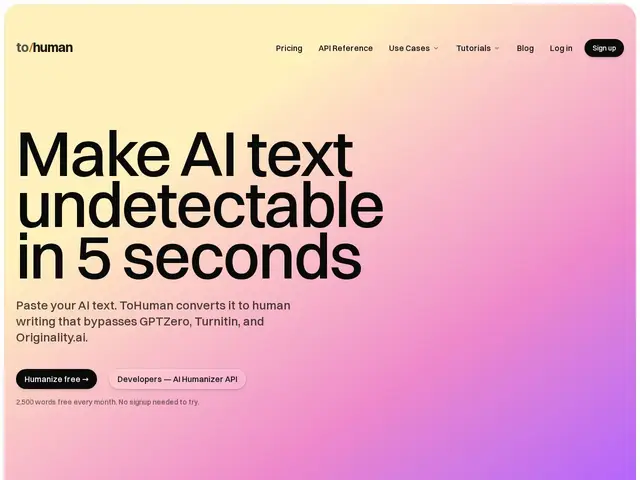
Description
A lot of 'AI humanizer' tools are single web pages where you paste text and get a rewrite back. ToHuman is built for a different use case: developers who need that rewriting step baked into their own product or automation — a content pipeline, a chatbot, an internal tool — via a simple API call rather than a manual copy-paste workflow.
It's a single POST endpoint with three adjustable intensity levels (minimal, medium, heavy), running on a self-hosted, fine-tuned Mistral 7B model rather than routing through OpenAI or another third party — which the product frames as both a privacy and an infrastructure-independence advantage. It restructures sentence rhythm and cadence rather than simply swapping in synonyms, responds in 3-5 seconds on average, and ships with integration guides for n8n, Make.com, Zapier, LangChain and CrewAI. There's a free tier (2,500 words/month, no card) and a $19/month Pro tier for 100,000 words, plus one-time word packs that never expire.
💬 Our review
The short version: ToHuman is aimed at developers building humanization into a pipeline, not people who just want to paste one essay and be done — and if that's your use case, the API-first design and self-hosted model are real advantages over consumer-facing humanizer sites.
The honest caveat that applies to every product in this category, including this one: there's no guaranteed bypass rate against AI detectors, and the product's own disclosed testing showed roughly 79% success against Turnitin on 500-word essays — useful context that most competitors don't publish at all. The self-hosted Mistral 7B model matters practically because it means no dependency on (and no cost tied to) a third-party API like OpenAI's, and the workflow-tool integrations (n8n, Zapier, LangChain) suggest a genuine developer audience rather than a marketing afterthought. The free tier is generous enough to test whether the output quality holds up for your specific use case before paying. Worth it if you're integrating humanization into an existing pipeline or product; overkill if you just need to rewrite one document occasionally, where a manual web-based humanizer would do the same job with less setup.
💰 Pricing
📊 Global score
🤖 AI-enriched data
Gratuit : 2500 mots/mois, sans CB. Pro : 19$/mois pour 100000 mots. Pack de mots : 9$ pour 50000 mots (n'expire jamais).
Pros
API simple, un seul endpoint POST
Modèle self-hosted (Mistral 7B fine-tuné), pas de dépendance à un tiers
3 niveaux d'intensité de réécriture ajustables
Guides d'intégration n8n, Make, Zapier, LangChain, CrewAI
Free tier généreux (2500 mots/mois sans CB)
Cons
Aucun taux de contournement garanti face aux détecteurs IA
Taux de succès mesuré ~79% sur Turnitin (essais 500 mots)
Pensé développeur, moins pratique pour un usage ponctuel non technique