Ruflo
A framework for running teams of AI agents that coordinate with each other, share a memory, and split up work — like a project manager for a crew of specialized AI workers instead of one generalist assistant.
🔗 Visit Ruflo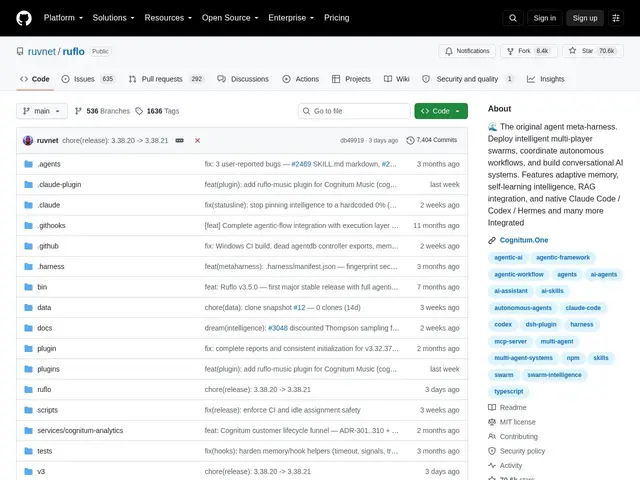
Description
A single AI agent handling an entire complex project — plan it, code it, test it, document it, secure it — tends to do all of those things adequately rather than any of them well. Ruflo takes a different approach: it coordinates a team of over 100 specialized agents (coding, testing, security, documentation, and more) that hand off work to each other, share a common memory, and can even split the work across multiple machines.
Ruflo (formerly known by other names in the ruv.io ecosystem) is an open-source orchestration framework built on Anthropic's Claude and other LLMs, offering hierarchical and mesh coordination topologies for how agents organize themselves, a vector memory system with HNSW indexing (AgentDB) for fast semantic recall, and a federation layer that lets agents collaborate across machines under zero-trust security. It ships 35 plugins covering orchestration, memory, security and DevOps, routes across multiple LLM providers (Claude, GPT, Gemini, Cohere, Ollama), and includes PII detection and behavioral trust scoring aimed at production security requirements. It's MIT-licensed, distributed via npm, with 70,600 GitHub stars, 8,400 forks and over 7,400 commits — genuinely large-scale adoption, though the project's own STATUS.md indicates it's not yet a 1.0 stable release, and it carries 635 open issues alongside 292 open pull requests, which is a lot of surface area still being actively worked through.
💬 Our review
The short version: if you're building AI-driven workflows complex enough that a single agent isn't cutting it, Ruflo gives you a genuinely large, actively-developed framework for coordinating many specialized agents — just expect pre-1.0 rough edges.
Against simpler multi-agent frameworks like CrewAI or LangGraph, Ruflo's edge is scale and depth: 100+ pre-built specialized agents, a real vector-memory layer instead of a bare context window, and a cross-machine federation layer with zero-trust security that most competitors don't attempt at all. The buzzword-heavy framing ("swarms," "self-learning intelligence") is worth reading past rather than taking literally — but the underlying numbers (70k+ stars, 8k+ forks, active security audit documentation) show this isn't hype without substance, it's a large, real open-source project. The catch is exactly what the maintainers themselves flag: pre-1.0 status with 635 open issues is a real signal of ongoing churn, so pin your dependency version and expect breaking changes between releases. Best for teams already comfortable operating complex agent orchestration who need the federation and memory depth; if you just need two or three agents talking to each other, a lighter framework like CrewAI will get you there with less overhead.
💰 Pricing
📊 Global score
🤖 AI-enriched data
Gratuit, licence MIT ; services entreprise sur demande via ruv.io
Pros
100+ agents spécialisés prêts à l'emploi (code, tests, sécurité, docs)
Mémoire vectorielle avec indexation HNSW pour un rappel sémantique rapide
Couche de fédération cross-machine avec sécurité zero-trust
Adoption réelle et large : 70 600 étoiles GitHub, développement actif
Cons
Pas encore en version 1.0 stable selon le propre STATUS.md du projet
635 issues ouvertes / 292 PR ouvertes — surface de churn importante
Langage marketing chargé en buzzwords (« swarms », « intelligence auto-apprenante ») à prendre avec recul
Complexité de mise en place plus élevée qu'un framework multi-agent simple