Ponytail
A free plugin that trains your AI coding assistant to stop and check whether a feature actually needs new code before it writes any — like having a skeptical senior developer review every suggestion first.
🔗 Visit Ponytail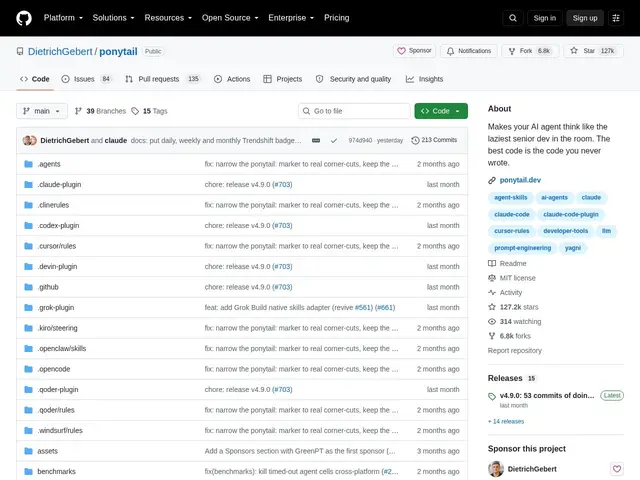
Description
AI coding assistants have a habit of writing more code than necessary — reinventing a helper function that already exists in your codebase, or reaching for a new dependency when the standard library already does the job. Ponytail is a small plugin that changes how the assistant thinks before it writes anything: it walks through a checklist (does this need to exist? is it already in the codebase? can the standard library handle it?) and only writes new code once those options are exhausted, the same discipline an experienced developer applies out of habit.
Ponytail is an open-source skill/plugin compatible with Claude Code, GitHub Copilot, Codex, Gemini and over a dozen other AI coding platforms, installed via each platform's plugin system (e.g. `/plugin install ponytail@ponytail` for Claude Code). It applies a seven-step decision ladder before generating code, offers configurable intensity modes (lite, full, ultra, off), and ships commands for code review, technical-debt auditing and impact scoring, while explicitly preserving validation, error handling, security and accessibility rather than trimming those away. It grew extremely fast — over 127,000 GitHub stars and 6,800 forks in a few months — largely on a headline claim of 80-94% less code generated. That specific number turned out to be based on a flawed benchmark; after a contributor challenged it publicly, the maintainer rebuilt the benchmark and published a more conservative figure of roughly 54% code reduction, alongside more modest measured gains (~22% token reduction, ~27% faster task completion).
💬 Our review
The short version: if your AI coding agent tends to over-engineer or duplicate existing code, Ponytail is a free, install-in-a-minute plugin that measurably cuts the bloat — just don't take the viral marketing numbers at face value.
Against general-purpose linters like ESLint or static-analysis tools like SonarQube, Ponytail's edge is that it intervenes before code is written rather than flagging it afterward, which fits naturally into an agentic workflow where you're reviewing agent output rather than writing every line yourself. The benchmark controversy is worth knowing about specifically because it's a live case study in how fast-growing open-source AI tooling can outrun its own evidence: the original 80-94% claim drove much of its explosive star growth, and the maintainer's public walk-back to ~54% is actually a point in its favor — it shows the project responds to scrutiny rather than burying it. Given it's free, MIT-licensed and has no downside beyond installation time, it's an easy trial for any team using Claude Code, Copilot or similar; just verify the reduction on your own codebase rather than assuming the marketed number applies.
💰 Pricing
📊 Global score
🤖 AI-enriched data
Gratuit, licence MIT, installation via marketplace de plugins (Claude Code, Copilot, Codex, Gemini, 20+ plateformes)
Pros
Gratuit et open-source (MIT), installation en une commande sur 20+ plateformes d'agents
Intervient avant l'écriture du code plutôt qu'en correction a posteriori
Le mainteneur a corrigé publiquement un benchmark exagéré — signal de sérieux
Préserve explicitement validation, gestion d'erreurs, sécurité et accessibilité
Cons
Le chiffre phare (80-94% de code en moins) qui a fait sa viralité était basé sur un benchmark biaisé, révisé à ~54%
Gain réel mesuré plus modeste (~22% de tokens en moins, ~27% plus rapide)
Efficacité dépendante de la plateforme d'agent utilisée et de son propre respect des règles