InterMCP
A tiny, extremely fast piece of plumbing that lets AI assistants like Claude talk to your files, databases and dev tools safely, instead of each app reinventing that connection from scratch.
🔗 Visit InterMCP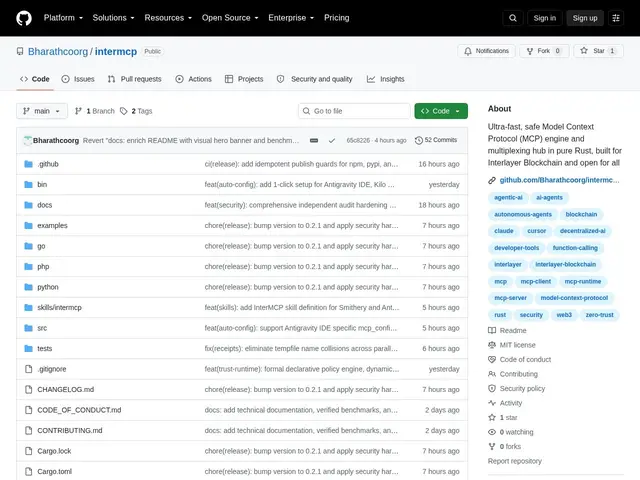
Description
When an AI assistant needs to read a file, query a database, or run a command on your machine, it needs a safe, standardized way to ask for permission and get an answer — that's what the Model Context Protocol (MCP) is for, and InterMCP is an engine that implements it with almost no overhead. Think of it as the express lane between an AI model and your tools: instead of a slow, memory-hungry bridge, it's a few megabytes of Rust that starts in under half a millisecond.
InterMCP is a pure-Rust MCP implementation with zero runtime dependencies, built to let LLM clients (Claude Desktop, Cursor, Windsurf, Zed) interface safely with developer tools, file systems and databases. It claims 457,000 operations/second single-core throughput, a 0.4ms cold boot, and under 3.8MB of RAM — figures that, if accurate, put it well ahead of typical Node.js-based MCP servers on both latency and footprint. It acts as a hub that aggregates multiple external MCP servers behind one connection, adds a SafeFS sandbox that blocks directory-traversal and credential-file access, includes agent-loop protection to catch runaway iteration, and automatically redacts secrets from environment variables before they reach a model. It's published under MIT across five package ecosystems (Rust, npm, PyPI, Packagist, Go) with SDKs in each language and auto-configuration for over ten IDE environments, plus documented Architecture Decision Records and a formal security policy. The catch: at the time of writing it has just 1 GitHub star and 0 forks, so despite the technically sophisticated implementation, it has essentially no visible real-world adoption yet.
💬 Our review
The short version: if you're building or configuring MCP integrations and performance/footprint genuinely matters — embedded contexts, high-throughput tool calls, resource-constrained environments — InterMCP is a legitimate, well-documented Rust alternative to the more common Node-based MCP servers, but it's untested by any real community yet.
Against the Node.js MCP servers that most Claude Desktop/Cursor users currently run, InterMCP's actual differentiator isn't a feature — it's the runtime: pure Rust with zero dependencies means sub-millisecond startup and single-digit-megabyte memory use, plus a sandboxing and secret-redaction layer baked into the engine rather than bolted on by each integration. The security posture (SafeFS sandbox, agent-loop protection, HMAC receipts) also reads like something built by someone who's thought seriously about what goes wrong when you give a model file-system access. That said, one star and zero forks means nobody has meaningfully stress-tested this outside the author, so treat the benchmark numbers as unverified until you or someone else reproduces them, and prefer it for personal or experimental setups over anything you'd bet a production pipeline on today.
💰 Pricing
📊 Global score
🤖 AI-enriched data
Gratuit, licence MIT, publié sur crates.io, npm, PyPI, Packagist et pkg.go.dev
Pros
Rust pur, zéro dépendance runtime : démarrage en 0.4ms, <3.8MB RAM revendiqués
Sandboxing SafeFS intégré (anti path traversal, blocage fichiers credentials)
Protection contre les boucles d'agent qui s'emballent + rédaction automatique de secrets
SDKs publiés dans 5 écosystèmes (Rust, npm, PyPI, Packagist, Go) avec auto-config pour 10+ IDE
Cons
Seulement 1 étoile GitHub, 0 fork — quasi aucune adoption réelle vérifiable
Chiffres de performance non vérifiés indépendamment
Pas encore éprouvé en production par une communauté externe