Computable GPU Index
An open, reproducible price index that tells you the real going rate for renting an H100 or B200 GPU right now, instead of guessing from scattered provider price pages.
🔗 Visit Computable GPU Index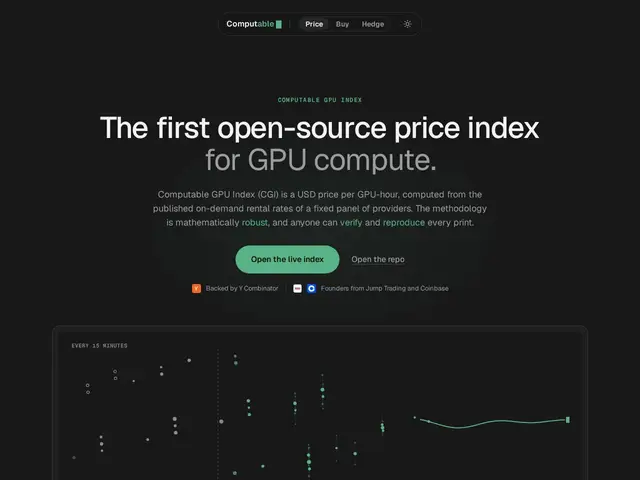
Description
If you've ever tried to figure out whether a cloud GPU rental is a fair price, you know the problem: every provider quotes differently, prices change by the hour, and there's no equivalent of a stock ticker for compute. Computable GPU Index fixes that by publishing a single, transparent number — in dollars per GPU-hour — recalculated every 15 minutes from a fixed panel of real provider rates, the same way a financial index tracks a basket of stocks.
Computable GPU Index (CGI) is an open-source, verifiable price benchmark for GPU compute, currently tracking H100, H200, B200 and B300 accelerators. Every print is computed from published on-demand rental rates collected from a fixed panel of providers, using an outlier-resistant interquantile mean rather than a simple average, so a single provider spiking its price can't distort the index. The entire pipeline — collector code, methodology, panel inputs, and every historical value — is open on GitHub under Apache 2.0, meaning anyone can clone the repo and recompute any past print to get the exact same number that was published. Access is anonymous and free: a live chart on the website, a public REST API, an MCP endpoint for agents, and the raw Git history for anyone who wants to audit it. Built by a Y Combinator-backed team with a finance/trading background (Jump Trading, Coinbase alumni), it's positioned as infrastructure for anyone pricing, trading, or budgeting GPU compute rather than a product you buy.
💬 Our review
The short version: if you're renting GPUs at any real volume and have no idea whether the quote you're getting is competitive, CGI gives you a free, auditable reference price instead of trusting a single provider's marketing page.
CGI's real differentiator against a provider's own pricing page or a closed third-party index is verifiability: the methodology, collector code and every historical print are open on GitHub, so you (or a skeptical finance team) can recompute any number and confirm it wasn't cherry-picked. The interquantile-mean approach also means one provider having a bad pricing day doesn't skew the whole index, which matters if you're using this number to negotiate or to budget. The catch is coverage — only four GPU generations tracked, and at 13 GitHub stars it's genuinely early, so treat it as a useful reference point rather than the definitive market price until it's been running longer. Best suited for teams renting meaningful GPU volume who want an objective anchor price; overkill if you're spinning up a single instance for a weekend project.
💰 Pricing
📊 Global score
🤖 AI-enriched data
100% gratuit, accès anonyme en lecture seule via site, API REST publique ou MCP — aucune clé requise
Pros
Méthodologie 100% open-source et reproductible — n'importe qui peut recalculer n'importe quel print historique
Recalcul toutes les 15 minutes sur un panel fixe de fournisseurs, moyenne interquantile anti-outlier
Accès gratuit et anonyme (site, API REST, MCP) sans compte ni clé
Porté par une équipe issue de la finance quantitative (Jump Trading, Coinbase)
Cons
Couverture limitée à 4 générations de GPU (H100/H200/B200/B300) pour l'instant
Projet encore jeune (13 étoiles GitHub) malgré un backing YC — traction réelle à confirmer
Ne couvre que le panel de fournisseurs choisi, pas l'exhaustivité du marché spot