ctx
Search your past AI coding agent sessions like git blame — and trace any line of code back to the exact agent conversation that wrote it.
🔗 Visit ctx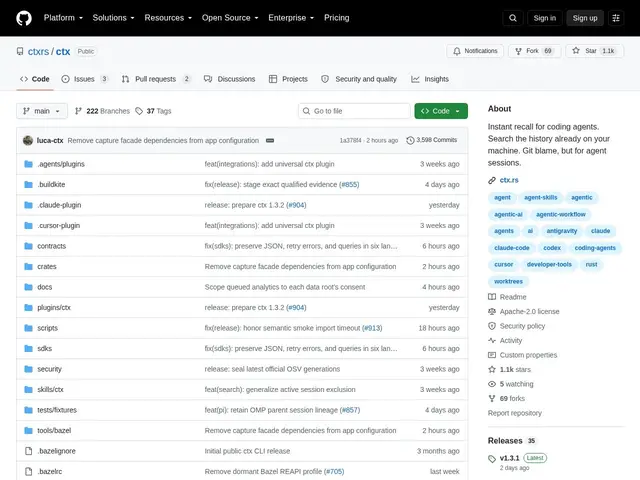
Description
When you use `git blame` on a confusing line of code, you can at least see who wrote it and when. But when an AI coding agent wrote that line, git blame just shows you your own commit — it doesn't show you why the agent made that choice, what you asked for, or what else happened in that session. ctx fills that specific gap: it's git blame, but for AI-agent-authored code.
ctx is a local-first Rust CLI tool (SQLite storage, Tantivy for search indexing) that indexes the session transcripts and tool-call history already sitting on your machine from over 40 supported coding agents — including Claude Code, Cursor, GitHub Copilot, Continue, and OpenHands — and makes them searchable via lexical or local semantic search, with no cloud API calls and no data leaving your machine. The free tier covers that search functionality; the paid “ctx pro” tier ($20/month, 14-day free trial) adds “ctx blame,” which traces any specific line of code back to the exact agent session and conversation that generated it, similar to how git blame maps a line to a commit. It's Apache-2.0 licensed with over 1,100 GitHub stars.
💬 Our review
The short version: if you've ever stared at a piece of AI-generated code wondering what you actually asked for or why the agent did it that way, ctx is a genuinely useful missing layer — the free tier alone (searchable local history) is worth installing, and the $20/month “blame” feature is worth it specifically if code provenance and auditability matter to your work.
Against general-purpose agent-memory platforms like Mem0 or Zep, ctx's focus is narrower and more concrete: it's not trying to give your agent long-term memory across sessions, it's giving you, the human, fast retrieval and provenance over sessions that already happened. Against a code-search tool like Sourcegraph, ctx is agent-transcript-specific rather than codebase-wide, which is exactly the niche that a git-blame analogy implies. With over 1,100 stars and support for 40+ agents, this is one of the more established tools in the emerging “agent session forensics” space, and being local-first with no cloud dependency is a meaningful trust signal for anyone worried about sensitive session data leaving their machine. The free tier is genuinely useful on its own; pay for “ctx pro” once you actually need to answer “which session wrote this line” rather than just “what did I discuss last week.”
💰 Pricing
📊 Global score
🤖 AI-enriched data
Gratuit pour la recherche locale dans l'historique des sessions ; ctx pro à $20/mois (essai gratuit 14 jours) pour la fonction de traçabilité 'blame'.
Pros
Traçabilité ligne de code vers session agent exacte ('ctx blame')
100% local, aucun appel cloud, aucune fuite de données
Compatible 40+ agents de code (Claude Code, Cursor, Copilot, Continue, OpenHands...)
Palier gratuit réellement utile, pas juste un essai bridé
Bien établi pour cette niche (1100+ étoiles GitHub)
Cons
La fonctionnalité phare 'blame' est payante ($20/mois)
Utilité proportionnelle au volume de sessions déjà accumulées
Périmètre plus étroit qu'un outil de recherche de code complet comme Sourcegraph