Aurict
A terminal-native AI coding assistant with full project context, 30+ language server integrations, and multi-agent task orchestration.
🔗 Visit Aurict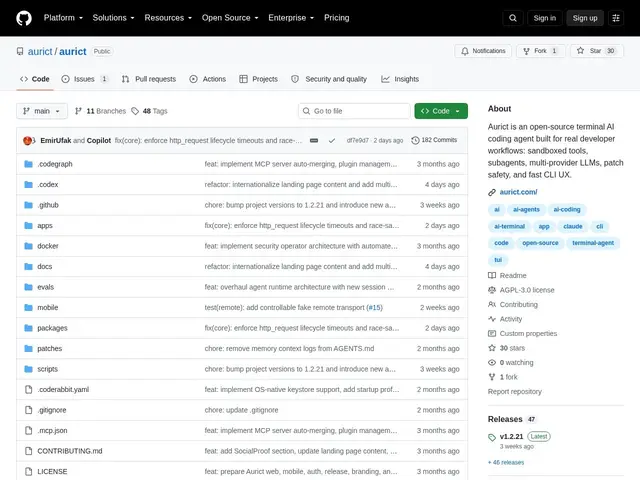
Description
Most AI coding assistants live inside an editor window or a browser tab, which means switching context every time you want to actually run something, check a log, or use a tool you already have configured in your terminal. Aurict takes the opposite approach: it's an AI agent that lives in your terminal, with direct access to your project files, shell commands, and language servers, so it works inside the environment you already use instead of asking you to move into a new one.
Aurict is an open-source (AGPL-3.0) TypeScript application built on Bun and Ink (React for terminals), offering automatic repository context analysis, permission-gated tool execution with a three-tier bash command classifier (safe/warning/danger), and the ability to distribute complex tasks across specialized worker agents rather than a single monolithic one. It supports 30+ language LSPs and MCP servers, persists session memory in SQLite via Drizzle ORM, and ships with 218+ framework-specific skills plus over 150 design systems for component generation. It works with Anthropic, OpenAI, Google, OpenRouter, or local Ollama models, and also includes a web platform for auth/docs and a companion Flutter mobile app.
💬 Our review
The short version: if you live in the terminal and want an AI coding agent that doesn't force you into a separate IDE window, Aurict packs in real engineering depth (LSP integration, permission-gated execution, multi-agent task splitting) for free — the cost is the AGPL license, which matters if you'd ever want to build a closed-source product on top of it.
Against Claude Code or Codex CLI, Aurict's differentiators are its risk-tiered command classifier (an explicit safe/warning/danger gate before running shell commands) and native multi-agent task distribution, which those tools handle less explicitly. It's open-source and self-hosted, which appeals if you don't want to depend on a vendor's cloud service, but you'll need your own API keys for whichever LLM provider you pick, so it's not actually free to run at scale — you're paying token costs either way. The AGPL-3.0 license is the real practical catch: it's fine for personal or internal use, but it has copyleft implications if you build a commercial product around it. Solid pick for a developer who wants a highly configurable, terminal-first agent and doesn't mind managing their own API keys and reading AGPL terms carefully first.
💰 Pricing
📊 Global score
🤖 AI-enriched data
Gratuit et open source (AGPL-3.0), nécessite vos propres clés API du fournisseur LLM choisi.
Pros
Intégration terminal profonde (shell, fichiers, 30+ LSP)
Distribution multi-agent des tâches complexes
Classification explicite du risque des commandes shell (safe/warning/danger)
Compatible avec plusieurs fournisseurs LLM dont Ollama local
Cons
Licence AGPL-3.0 contraignante pour un usage commercial fermé
Coûts API LLM à votre charge malgré la gratuité de l'outil
Adoption encore modeste (30 étoiles) vis-à-vis de l'ampleur des fonctionnalités