ActraDeck
Puts a human approval gate in front of risky Claude Code / Codex actions, with secret redaction and replayable audit trails.
🔗 Visit ActraDeck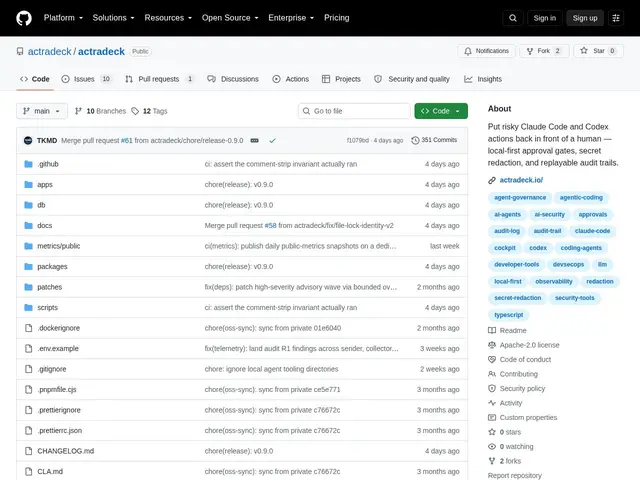
Description
Picture an intern with full computer access who moves incredibly fast but occasionally does something you really wish you'd caught before it happened — deletes the wrong file, runs a destructive command, or pastes a secret key somewhere it shouldn't go. That's the real risk of letting AI coding agents like Claude Code or Codex act autonomously on your machine. ActraDeck sits between the agent and your system as a local checkpoint: before a risky action runs, it stops and asks a human to approve, deny, or edit it.
ActraDeck is a local-first, open-source (Apache 2.0) TypeScript application built around four functions: Review (allow/deny/approve pending agent actions before execution), Redact (automatically mask credentials and secrets so they never leak into logs or chat), Replay (inspect past sessions for audit purposes), and Unify (a shared approval history across both Claude Code and Codex, so you're not managing two separate trust systems). It uses pattern-based risk detection to flag what's dangerous, runs entirely on your machine with telemetry off by default, and installs via a native installer, Docker, or manual setup on Node.js 22.16+.
💬 Our review
The short version: if you let AI coding agents run commands on your machine and have ever had that small moment of dread right before approving a broad permission grant, ActraDeck gives you a concrete, inspectable checkpoint instead of blind trust — the tradeoff is it's a very young project (0 stars, no visible track record yet) that adds a layer you have to configure and maintain.
There isn't a well-established direct competitor doing exactly this for Claude Code and Codex specifically; most people currently rely on the agent platforms' own built-in permission prompts, which are coarser-grained and don't give you replayable audit trails or unified history across tools. ActraDeck's real value is narrow and specific: secret redaction and replay matter a lot if you're running agents against production-adjacent systems or work under any kind of compliance requirement, less so for solo hobby projects. Being open-source and free removes the cost question, but you're trusting a brand-new, low-adoption project to correctly classify what's “risky” — a false negative defeats the entire point. Worth trying now if you already had a near-miss with agent permissions; fine to wait for more adoption/scrutiny if you haven't.
💰 Pricing
📊 Global score
🤖 AI-enriched data
Gratuit et open source (Apache 2.0), auto-hébergé.
Pros
Checkpoint d'approbation concret avant exécution d'actions risquées
Rédaction automatique des secrets/identifiants
Historique d'audit rejouable
Unifie Claude Code et Codex sous une seule couche d'approbation
Cons
Projet très jeune (0 étoile GitHub), aucun retour d'expérience public
Détection de risque basée sur des patterns, peut manquer des cas nouveaux
Overhead de configuration supplémentaire