TraceLint
A deterministic linter for AI agent execution traces — catches schema violations, ignored tool errors, and hallucinated arguments before they ship.
🔗 Visit TraceLint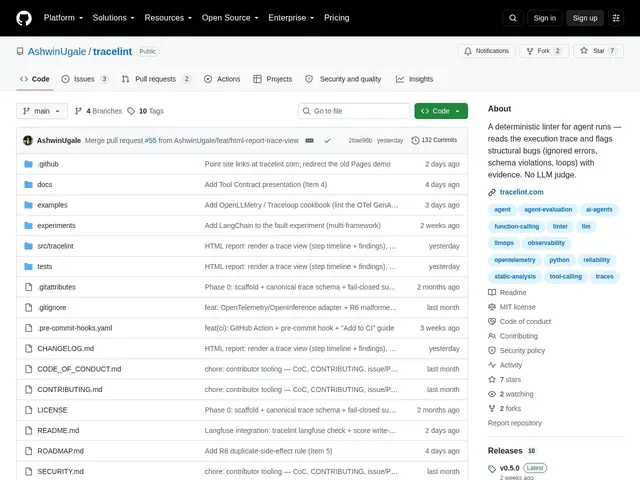
Description
When an AI agent calls tools and APIs to get work done, it's easy to assume it's working correctly just because it didn't crash — but agents can silently ignore a tool's error message, call the same tool in a pointless loop, or invent an argument that doesn't match what the tool actually expects. Reading through raw execution logs to catch these problems by hand doesn't scale past a handful of runs. TraceLint automates that check.
TraceLint is a Python tool (pip installable, Python 3.10-3.12) that reads the execution trace of a tool-calling agent — what it actually did, not what it claims to have done — and reports structural defects using seven deterministic rules covering schema violations, ignored tool errors, hallucinated arguments, redundant calls, and loops. It supports several trace formats out of the box (its own native JSON, OpenAI's message format, Langfuse, LangSmith, and OpenTelemetry/OpenInference), integrates into CI/CD via GitHub Actions or pre-commit hooks, outputs SARIF for GitHub code scanning, and includes a “recovery scorecard” for measuring how an agent behaves when you deliberately inject faults into its environment.
💬 Our review
The short version: if you're shipping an AI agent product and have ever wondered whether it's silently ignoring tool errors or looping pointlessly in production, TraceLint gives you deterministic, rule-based answers instead of manually reading transcripts — it's a young project (7 stars) so the rule set (currently seven rules) is still narrow relative to the full space of things that can go wrong with agents.
Most teams currently catch these issues either by manual transcript review or by relying on the observability platforms themselves (Langfuse, LangSmith) for general tracing without a dedicated linting layer on top — TraceLint's value is specifically the deterministic, CI-integrable linting step, which those platforms don't provide out of the box. Being free, open-source, and lightweight (minimal dependencies) makes it low-risk to try. The real limitation is coverage: seven rules is a solid start but won't catch every failure mode, so it complements rather than replaces good evals and human review. Worth adding to your CI pipeline now if you're already using Langfuse, LangSmith, or OpenTelemetry for agent tracing and want an automated first pass before a human looks at anything.
💰 Pricing
📊 Global score
🤖 AI-enriched data
Gratuit, installable via pip, licence MIT.
Pros
Détection déterministe par règles, résultats reproductibles
Compatible avec plusieurs formats de trace existants
Intégration CI/CD prête à l'emploi (GitHub Actions, SARIF)
Gratuit et open source, dépendances minimales
Scorecard de récupération après injection de fautes
Cons
Seulement 7 règles de détection pour l'instant, couverture encore étroite
Projet jeune (7 étoiles)
Complète mais ne remplace pas une revue humaine ou de vraies evals