lla.ma
Developer infrastructure that gives you one API endpoint for building, running, and monitoring AI agents across multiple LLM providers, instead of juggling separate SDKs and dashboards.
🔗 Visit lla.ma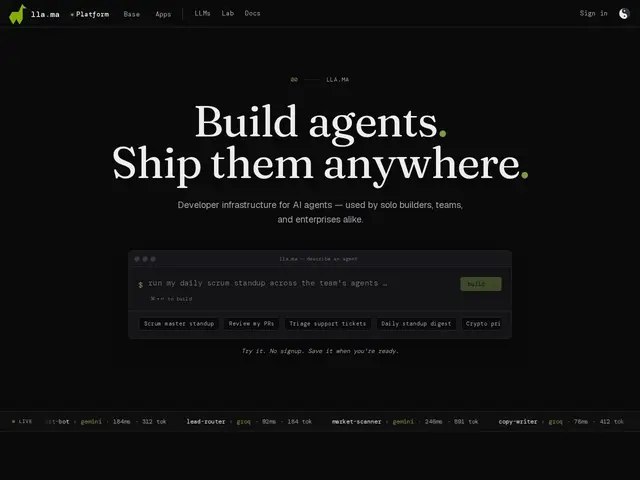
Description
If you've ever built something that calls more than one AI provider, you know the pain: each one has its own SDK, its own way of counting cost, its own dashboard to check when something breaks, and no shared view of what your agent actually did across a run. lla.ma tries to collapse all of that into one place.
lla.ma is developer infrastructure for building and operating AI agents: a single API endpoint that routes requests across Anthropic, OpenAI, Google, and Groq with automatic fallback, so a provider outage or rate limit doesn't take your agent down. It adds the operational layer most teams end up hand-building themselves — key-value memory for agent state, budget controls per project, SSE streaming, and detailed execution telemetry with cost tracking down to individual runs. Pricing scales by number of custom agents and monthly token volume rather than by seat, from a free tier (1 agent, 100k tokens/month) up to a Team plan (15 agents, 15M tokens/month).
💬 Our review
The short version: lla.ma is a solid pick if your actual pain point is provider sprawl and blind spots in agent observability — one endpoint, automatic fallback, and real telemetry — but you still need your own provider API keys, so it's an operations layer, not a way to avoid LLM costs.
The closest comparisons are LangSmith (strong on tracing and evals, but bolted onto LangChain's ecosystem rather than a standalone routing layer) and the Vercel AI SDK (great for wiring providers into an app, but you still own fallback logic and telemetry yourself). Dify sits at a different layer entirely — a no-code agent builder aimed at people who don't want to write routing or telemetry code at all. lla.ma's differentiator is narrower and more concrete: multi-provider fallback plus cost-tracked telemetry as a managed service, which matters most once you have an agent in production and a provider outage or rate-limit spike becomes a real incident, not a hypothetical. If you're still prototyping a single-provider agent, the $20-99/month tiers are hard to justify; if you're running one in production across providers, the operational visibility alone can pay for itself.
📊 Global score
🤖 AI-enriched data
Gratuit (1 agent personnalisé, 100k tokens/mois), Developer 20$/mois (3 agents, 5M tokens/mois), Pro 50$/mois (7 agents, 10M tokens/mois), Team 99$/mois (15 agents, 15M tokens/mois). Agents supplémentaires facturés en sus selon le palier.
Pros
Endpoint unique routant vers quatre fournisseurs LLM (Anthropic, OpenAI, Google, Groq) avec fallback automatique
Télémétrie détaillée avec tracking des coûts par exécution
Mémoire clé-valeur et budgets contrôlés intégrés, sans code custom à écrire
Cons
Nécessite ses propres clés API pour chaque fournisseur utilisé — ne remplace pas les coûts LLM
Tarification par tokens/mois, potentiellement rigide pour un usage très irrégulier
Pas d'alternative auto-hébergée : uniquement en SaaS géré