Snitch
Slack bot that builds and maintains your org chart automatically by asking employees who they report to
🔗 Visit Snitch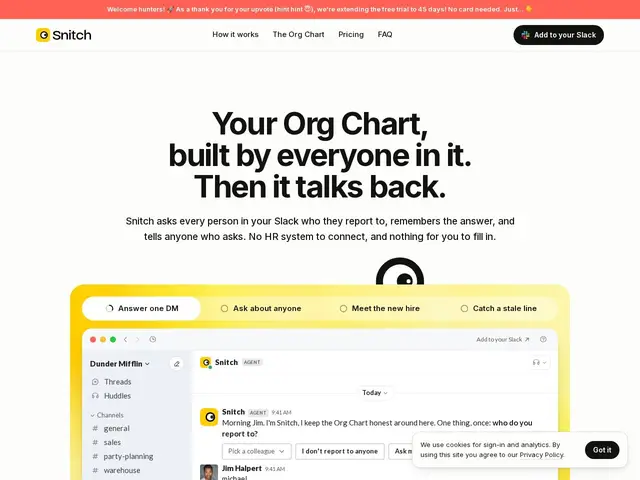
Description
Org charts almost always drift out of date the moment someone changes teams or a new hire joins, because updating them means someone in HR remembering to edit a slide or a spreadsheet. Snitch skips the manual update entirely by asking the question directly, in Slack, to the people who actually know the answer.
The bot messages employees to confirm their reporting relationship, then assembles those crowdsourced answers into a live organizational chart — no HR system integration required. It automatically flags anomalies like reporting loops or invalid manager assignments, and updates continuously as people join, leave, or change roles; anyone on the team can also just ask the bot who reports to whom.
💬 Our review
The short version: for a company that lives in Slack and has an org chart nobody trusts, Snitch's crowdsourced-and-continuous approach solves the actual failure mode of most org charts — that a human forgot to update them.
It's not really competing with HRIS platforms like Lattice or 15Five, which manage org structure as part of a broader HR suite; Snitch is a narrower, Slack-native tool for teams that don't want (or can't justify) a full HR system just to answer "who's my manager's manager." The tiered pricing (€19-59/month by headcount) is modest for the problem it solves, and the 45-day free trial without a credit card is generous enough to see if your team actually responds to the bot's prompts — the main risk is any tool this dependent on crowdsourced input, since it only stays accurate if people answer honestly and promptly.
📊 Global score
🤖 AI-enriched data
19 €/mois jusqu'à 50 personnes, 39 €/mois pour 51-100, 59 €/mois pour 101-200. Essai gratuit de 45 jours sans carte bancaire.
Pros
Organigramme automatique sans intégration à un système RH
Précision crowdsourcée : chaque employé confirme sa propre relation hiérarchique
Mise à jour continue et détection d'anomalies (boucles hiérarchiques, managers invalides)
Cons
Dépend entièrement de Slack, pas d'utilisation autonome
Pas d'intégration avec les systèmes RH existants pour validation croisée
Fiabilité dépendante de la participation réelle des employés