Declick
Compiles OpenAPI specs, MCP servers or SQLite databases into lightweight CLI tools, cutting agent context by ~4x
🔗 Visit Declick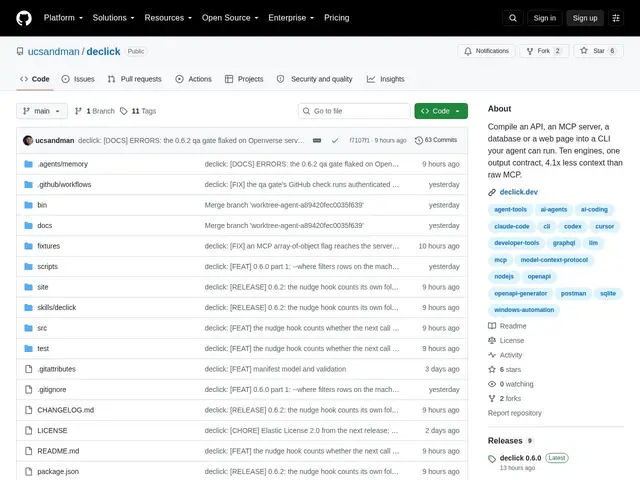
Description
Every tool schema an AI agent has access to eats into its context window on every single turn, whether or not that tool is actually used. Declick's idea is to compile all of that once into a compact CLI, so an agent carries a short list of commands around instead of the full raw schema every time.
Declick is a compiler that transforms APIs, MCP servers, and databases into named command-line verbs that AI agents can invoke efficiently. It consolidates OpenAPI, GraphQL, SQLite, Postman, HAR, MCP servers, CLI tools, web pages and even desktop apps into unified shell-based tools with standardized JSON output and defined exit codes. The vendor reports roughly a 4.1x reduction in context tokens compared to raw MCP implementations (236KB down to 58KB across 9 real servers with 258 tools in one benchmark), plus optional governance for mutation approval and audit logging.
💬 Our review
The short version: context-window cost is a real, underrated tax on agent tool use, and compiling schemas once instead of carrying them every turn is a legitimate, measurable way to cut it.
Compared to raw MCP server integrations or hand-written CLI wrappers, Declick's pitch is breadth (10+ source types unified under one output contract) plus the measured token savings. The catch is licensing: it's Elastic License 2.0, meaning free for individuals and small organizations (under 10 people) but $19/developer/month for larger teams, and commercial redistribution is prohibited — a real difference from fully open tools like openapi-generator. With 6 GitHub stars, it's early. Worth it if you're hitting real context-window limits with multiple MCP servers and want measured savings; a simple team can likely get by without it.
📊 Global score
🤖 AI-enriched data
Gratuit pour particuliers et organisations de moins de 10 personnes. Payant : 19 $/développeur/mois (ou 190 $/an) pour les équipes plus grandes ; support production 2000 $/an. Licence Elastic License 2.0 (redistribution commerciale interdite).
Pros
Réduction mesurée d'environ 4,1x du contexte en tokens face à des implémentations MCP brutes
Prend en charge plus de 10 types de sources (OpenAPI, GraphQL, SQLite, Postman, HAR, MCP, CLI, pages web...)
Zéro dépendance runtime, déploiement léger
Contrat de sortie standardisé (codes de sortie, enveloppe JSON) cohérent entre sources hétérogènes
Cons
Adoption précoce (6 étoiles), peu de retours d'usage réel
Licence Elastic 2.0 : redistribution commerciale interdite, code propriétaire fermé après la v0.3.0
Coût (19 $/dev/mois pour les équipes) face à des alternatives open source gratuites comme openapi-generator