Casefile
Records the reasoning behind AI agent code changes alongside git commits, so you can retrieve the "why" later
🔗 Visit Casefile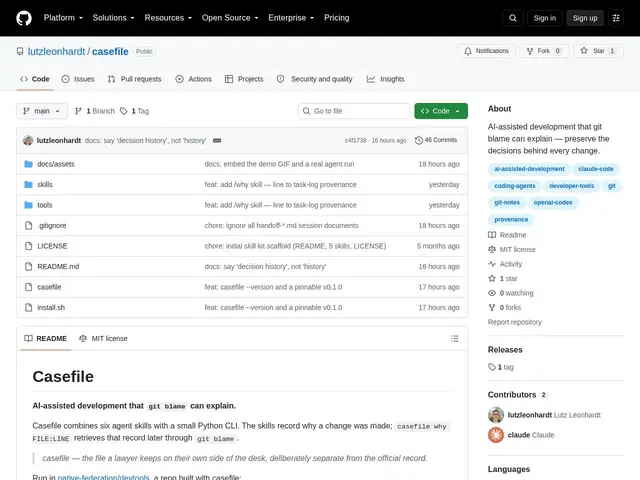
Description
Git tells you exactly what changed in a file. It tells you nothing about why an AI agent chose that approach over three others it considered. Casefile captures that missing half — the reasoning, rejected alternatives, and evidence behind a change — and ties it to the commit that resulted from it.
Casefile documents the decision context behind AI-agent code changes, complementing git's record of "what" with structured "why" history. It breaks specifications into commit-sized tasks, briefs agents with bounded context, and records intent, rejected alternatives, and supporting evidence. Logs attach either via git notes ("casefile" mode) or as direct commits ("home" mode), and multi-session task refinement is supported through log merging. It's built to work with Claude Code and Codex, and separates raw agent transcripts from the curated decision record.
💬 Our review
The short version: for teams that need to explain later why an AI agent made a particular change — for code review, compliance, or just your own sanity six months from now — Casefile is solving a real, mostly unaddressed gap.
There's no direct competitor doing structured agent-decision logging the same way; the practical alternative is just writing more detailed commit messages by hand, which most agent workflows don't do consistently. The tradeoffs are structural: git notes don't travel with a normal clone (they need manual restoration), and squash or rebase merges can break the link between a commit and its logged reasoning. With zero GitHub stars, it's unproven at scale. Free and worth trying if you already work with specifications broken into agent-sized tasks and want an audit trail; skip it if your team doesn't need that level of decision documentation.
📊 Global score
🤖 AI-enriched data
Gratuit, licence MIT.
Pros
Conserve le raisonnement derrière les changements de code à côté du contrôle de version
Prend en charge le raffinement multi-session avec fusion des journaux
Sépare les transcriptions brutes d'agent des enregistrements de décision épurés
S'intègre avec Claude Code et Codex
Cons
Aucune adoption mesurable sur GitHub (0 étoile, 0 fork)
Les fusions squash ou rebase cassent le lien entre commit et journal
Les git notes ne suivent pas un clone standard — restauration manuelle nécessaire
Portée étroite : ne gère que l'exécution une fois la spécification déjà définie