UBOM
Open-source part-number and taxonomy manager for hardware bill-of-materials workflows, with immutable revisions
🔗 Visit UBOM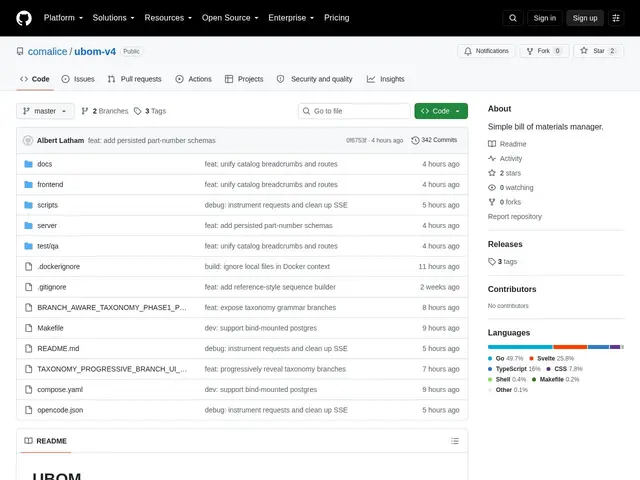
Description
Hardware and electronics teams often end up with part numbers assigned ad hoc, spreadsheet by spreadsheet, until nobody can tell which revision of a part was actually used in which product. UBOM gives that process a proper system: defined numbering rules, a searchable catalog, and a permanent record of what changed and when.
UBOM is a part-number and taxonomy manager built for engineering and manufacturing workflows. It lets you define part-number sequence grammars, organize parts into taxonomies, classify them, and search a catalog with filters and facets. Every part definition and taxonomy revision is immutable, giving a clean audit trail of what a part number meant at any point in time. It stores data in Postgres, SQLite, or memory, and deploys via Docker Compose with a browser UI and a Go-based API. It's currently single-user, with no authentication layer.
💬 Our review
The short version: the core idea — immutable, auditable part-number governance — is a real need in hardware engineering, but this is a pre-release, single-user tool, not something to run your production BOM process on yet.
Compared to full PLM platforms like OpenBOM or Arena Solutions, UBOM is dramatically narrower in scope: no BOM authoring, no CAD integration, no formal engineering change orders, and no multi-user support or login — it solves exactly the part-numbering and taxonomy slice of the problem, self-hosted and free. That narrowness is also the appeal if a full PLM system is overkill for a small team that just needs disciplined part numbers. Worth watching if you're a small hardware team wanting a lightweight, self-hosted numbering system; not ready for teams needing multi-user access control or full BOM management today.
📊 Global score
🤖 AI-enriched data
Gratuit, open source. Auto-hébergé via Docker Compose (Postgres, SQLite ou mémoire).
Pros
Révisions immuables des pièces et taxonomies, traçabilité complète
Multi-backend (Postgres, SQLite, mémoire) selon les besoins de déploiement
Stack complète : UI navigateur + API REST + déploiement Docker Compose
Répond à un vrai problème de gouvernance des références de pièces
Cons
Pré-version avec adoption minimale (2 étoiles, mono-utilisateur, aucune authentification)
Fonctions majeures absentes : rédaction de BOM, intégration CAO, contrôle de changement formel
Marché très niche (ingénieurs matériel), peu de recoupement avec l'audience SaaS/dev classique