Vise
Freezes your code's observable behavior into a lockfile so an AI refactor can be verified byte-for-byte, not trusted
🔗 Visit Vise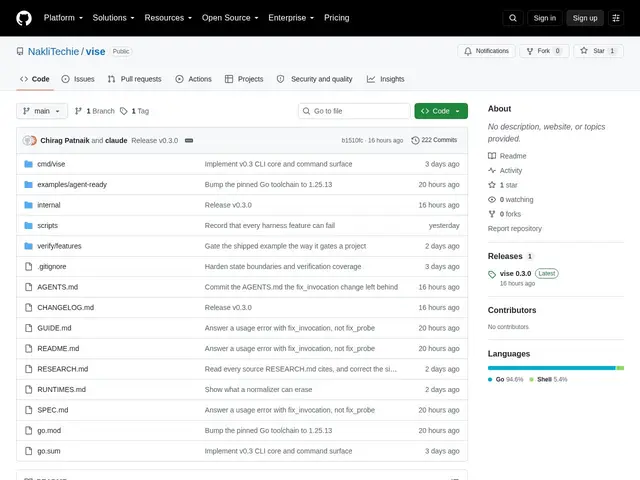
Description
When an AI agent refactors your code, how do you know it didn't quietly break something your test suite doesn't cover? Vise's answer is blunt but effective: record exactly what the program outputs today, then flag any byte-level difference after the refactor — before a human even looks at the diff.
Vise is a CLI tool that records baseline behavior through deterministic test probes defined in a vise.toml file, then gates subsequent changes against that frozen baseline via byte-level output comparison. It's built specifically for AI-assisted refactoring workflows: it returns typed exit codes (0 through 5) that an agent can interpret directly — proceed, revert, fix the probe, and so on — without needing an LLM call of its own. It's language-agnostic but requires a POSIX shell and genuinely deterministic probes, and ships with detailed documentation (AGENTS.md, SPEC.md, RUNTIMES.md) covering language-specific determinism traps.
💬 Our review
The short version: making an AI agent check its own refactor against frozen, byte-exact behavior — with no LLM call needed for the check itself — is a smart, cheap safety net that most refactor workflows lack entirely.
It doesn't compete directly with unit tests or snapshot testing so much as sit alongside them: your test suite checks intent, Vise checks that nothing else silently changed. The catch is that it's genuinely early (v0.3-dev, not yet packaged, 0 stars) and demands discipline to write deterministic probes yourself — there's no automatic test generation. It's POSIX-only, so no native Windows support. Worth adopting now if you're already running AI agents against a codebase unsupervised and want a hard gate on refactors; wait for a stable release if you need something turnkey today.
📊 Global score
🤖 AI-enriched data
Gratuit, open source, en développement actif (v0.3-dev, pas encore packagé). Nécessite Go 1.25.13+ pour compiler depuis les sources.
Pros
Vérification comportementale sans modifier le code ni appeler de LLM
Agnostique au langage, avec codes de sortie typés pensés pour être interprétés par un agent
Documentation soignée (spécification, guide agents, pièges de déterminisme par runtime)
Cons
Stade très précoce (v0.3-dev, pas encore packagé, 0 étoile)
POSIX uniquement, pas de support Windows natif
Exige de définir soi-même des probes déterministes, aucune génération automatique