Moadim
Rust daemon that runs Claude Code, Codex and other AI coding agents on cron-like schedules, with a dashboard, REST API and MCP
🔗 Visit Moadim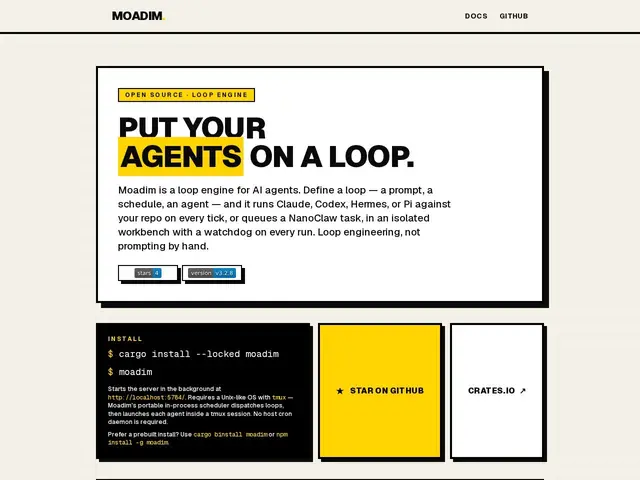
Description
Think of Moadim as cron for AI agents: instead of scheduling a script that always does the same thing, you schedule an agent that reads your repository and decides what to do — review a pull request, write a changelog, chase down a flaky test — on a timer, without anyone starting it by hand.
Under the hood, Moadim is a single Rust binary that orchestrates recurring "routines" defined as TOML configs, each pointing at a coding agent (Claude Code, Codex, Hermes, NanoClaw or Pi). Every run gets its own throwaway workbench directory so agents never trample each other, with overlap prevention, timeouts and concurrency caps built in. It ships three ways to manage routines — a browser dashboard, a documented REST API, and an MCP endpoint so another AI agent can configure Moadim itself. It requires tmux and Python 3 alongside the Rust binary, and is installable via cargo or npm.
💬 Our review
The short version: Moadim answers a real gap — most people wiring up recurring AI-agent tasks today glue together a shell cron job and hope for the best, with no isolation, no UI, and no safety rails against two runs overlapping.
Compared to that DIY route, or to cloud-only agent schedulers tied to one vendor, Moadim's pitch is model-agnosticism (Claude, Codex, Hermes, Pi in the same config) plus three separate control surfaces in one free, open-source binary. The catch: it's early and the TOML-based configuration plus tmux/Python dependency means it's aimed at people already comfortable running self-hosted infra, not a point-and-click product. Worth it if you already run scheduled agent jobs and want isolation and observability instead of bare cron; overkill if you just need one agent to run once a day and a GitHub Action would do.
📊 Global score
🤖 AI-enriched data
100% gratuit, licence MIT. Installation via cargo (Rust) ou npm. Nécessite tmux et Python 3 en plus du binaire Rust.
Pros
Multi-modèles (Claude, Codex, Hermes, NanoClaw, Pi) dans une seule config
Trois interfaces (dashboard, API REST, MCP) pour piloter les routines
Isolation par workbench jetable avec nettoyage automatique
Scheduler cross-platform, pas dépendant du cron du système
Cons
Dépendances supplémentaires (tmux, Python 3) en plus du binaire Rust
Configuration TOML — pas d'interface no-code pour démarrer
Projet jeune, écosystème encore à roder