Roost
Single-binary, browser-based remote dev workspace with persistent terminals, built for Claude Code and coding agents
🔗 Visit Roost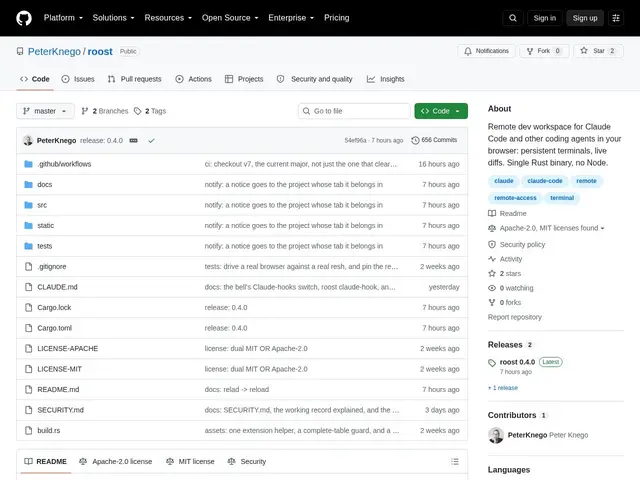
Description
If you've ever lost a long-running terminal session because your laptop went to sleep or a browser tab closed, Roost is built to fix exactly that: it runs your terminal on a server instead of your machine, so closing the tab doesn't kill what's running inside it.
Roost is a remote development environment shipped as a single self-contained Rust binary (about 4MB, using roughly 16MB of memory for 7 shells) with no Node.js or other external dependencies. It provides persistent terminals backed by dtach that survive disconnects, a file tree, a live diff viewer, a code editor and a preview pane, all accessible from any browser. It's built with explicit support for the Claude Code IDE protocol and other AI coding agents, and keeps state across browser tabs, with drag-and-drop uploads and desktop notifications.
💬 Our review
The short version: the engineering is genuinely lean — a 4MB binary with real persistent-session guarantees — but with 2 GitHub stars, you'd be using it before almost anyone else has vetted it.
Compared to GitHub Codespaces or Gitpod, Roost is far lighter weight (a single binary versus a managed cloud platform) and free/open source, but it also comes with none of their polish, support, or ecosystem — you're responsible for hosting it yourself. Its explicit design around the Claude Code IDE protocol makes it a natural fit if that's your daily driver, less relevant otherwise. Worth trying if you want a minimal, self-hosted, agent-friendly remote terminal and don't mind rough edges; stick with Codespaces or Gitpod if you want a managed, supported product.
📊 Global score
🤖 AI-enriched data
Gratuit, double licence Apache-2.0 / MIT. Auto-hébergé, aucun coût de service.
Pros
Binaire Rust unique, sans dépendance externe — déploiement simple
Sessions de terminal persistantes qui survivent aux déconnexions grâce à dtach
Empreinte mémoire minimale : 4 Mo de binaire, 16 Mo de RAM pour 7 shells
Intégration native au protocole IDE de Claude Code
Cons
Très faible visibilité GitHub (2 étoiles) — peu de validation communautaire
Marché de niche centré sur les agents de code, moins pertinent pour un usage généraliste
Documentation et base d'utilisateurs encore réduites