DanTerm
Fast, dependency-free macOS terminal built in Swift, with vertical tabs, split panes and AI-agent integrations
🔗 Visit DanTerm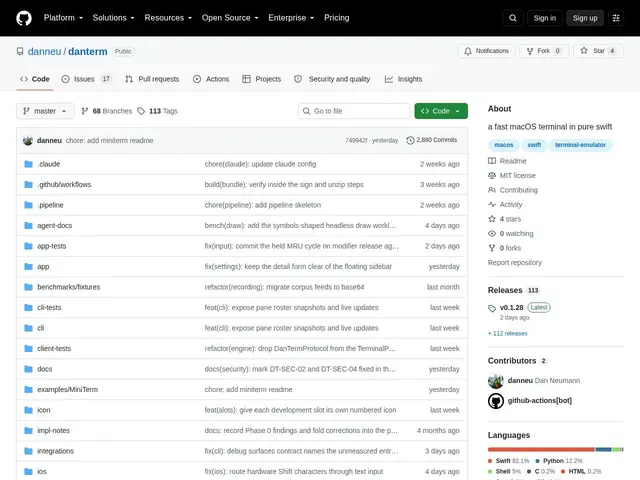
Description
Most terminal apps look and behave the same way they did a decade ago: one row of tabs, one pane. DanTerm rethinks the layout — tabs run down the side, panes split however you need — while staying fast enough that you don't notice the extra visual structure.
DanTerm is a macOS-only terminal emulator written entirely in Swift with zero third-party dependencies. Its headline features are vertical tab layouts and split panes, alongside persistent pane alerts, native macOS notifications, tab/pane crash recovery, local and remote color themes, a command-line scripting interface, and remote control over Tailscale tailnets — including experimental iPhone control. It integrates with Claude Code and Codex for AI-assisted terminal workflows. The author reports 127.2 MB/s ASCII rendering throughput and roughly 57MB of memory for 10 empty tabs. It requires macOS 26+ on Apple Silicon.
💬 Our review
The short version: the performance numbers and zero-dependency Swift build suggest real engineering care, but with 4 stars and 0 forks, this is very much a solo project you'd be adopting early, not a mainstream terminal replacement.
Against iTerm2, kitty or Ghostty — all far more established with larger communities and longer track records — DanTerm's differentiator is the vertical-tabs-plus-split-panes layout and built-in AI agent integration, which none of the big three treat as a first-class feature. The tradeoffs are real: macOS 26+ and Apple Silicon only, a single-maintainer project with 17 open issues, and an experimental iPhone control feature that's explicitly unfinished. Worth trying if the vertical-tabs layout and native Claude Code/Codex hooks genuinely solve a workflow problem for you; stick with iTerm2 or Ghostty if you want a terminal with a large user base behind it.
📊 Global score
🤖 AI-enriched data
Gratuit, licence MIT. Nécessite macOS 26+ sur Apple Silicon.
Pros
Haute performance : 127,2 Mo/s de rendu ASCII, empreinte mémoire minimale
Disposition en onglets verticaux et panneaux scindés, différenciateur rare sur le marché
Zéro dépendance tierce, écrit entièrement en Swift natif
Développement actif (2880 commits), intégrations récentes avec Claude Code et Codex
Cons
Adoption très faible : 4 étoiles GitHub, 0 fork, 0 pull request
Réservé à macOS, nécessite Apple Silicon et macOS 26+
Projet mono-auteur avec 17 issues ouvertes et fonctionnalités expérimentales (contrôle iPhone)