Covenant Framework
Open-source governance layer for multi-agent AI systems: agent roles, rules, memory and audit trails
🔗 Visit Covenant Framework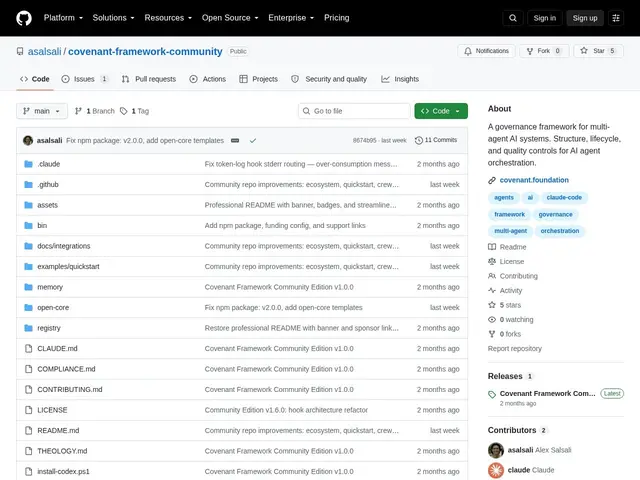
Description
Running one AI agent is manageable. Running a dozen of them together — each with its own job, all supposed to follow the same ground rules — gets chaotic fast without something enforcing order. Covenant Framework is an attempt to be that referee.
Covenant Framework is a governance layer for coordinating multiple AI agents in production. It ships 12 pre-configured agent roles (Interpreter, Analyst, Writer, Guardian and others), 16 core commands for agent interaction, a constitution-based rule system with 36 immutable governance rules, and semantic memory with exit reporting for auditability. It installs via pip and integrates with CrewAI, Claude Code and OpenAI Codex, aimed at teams that need coordination and quality controls across several agents rather than one.
💬 Our review
The short version: the architecture — fixed roles, immutable rules, an audit trail — is a sensible answer to real multi-agent coordination problems, but the project's public traction (5 stars, 0 forks, 11 commits) means you'd be an early adopter, not a user of a proven tool.
Compared to CrewAI or LangGraph, which focus on composing agent workflows, Covenant Framework leans harder into governance — rules the agents can't violate and reports of what happened — which is a narrower but more compliance-minded angle. It's free and open source, so the cost of trying it is just your time, but sparse documentation outside the README and minimal real-world usage examples mean you should expect to read source code to understand edge cases. Worth a pilot if strict, auditable multi-agent governance is a hard requirement; wait for more maturity if you just need agents to cooperate loosely.
📊 Global score
🤖 AI-enriched data
Édition Community gratuite et open source. Une édition "Network" avec fonctions avancées est mentionnée sans tarif public.
Pros
Modèle de gouvernance structuré avec 36 règles immuables, limite les dérives d'agents en production
Rôles d'agents préconfigurés (Interpreter, Analyst, Writer, Guardian...) qui réduisent le temps de mise en place
Mémoire sémantique et rapports de sortie pour l'auditabilité des workflows multi-agents
Installation CLI simple via pip, exemples de démarrage rapide inclus
Cons
Traction très faible (5 étoiles, 0 fork) sur GitHub
Documentation limitée en dehors du README
Historique de commits réduit (11), développement encore naissant