Telemetry.dev
Observability platform purpose-built for tracing and cost-tracking LLM applications
🔗 Visit Telemetry.dev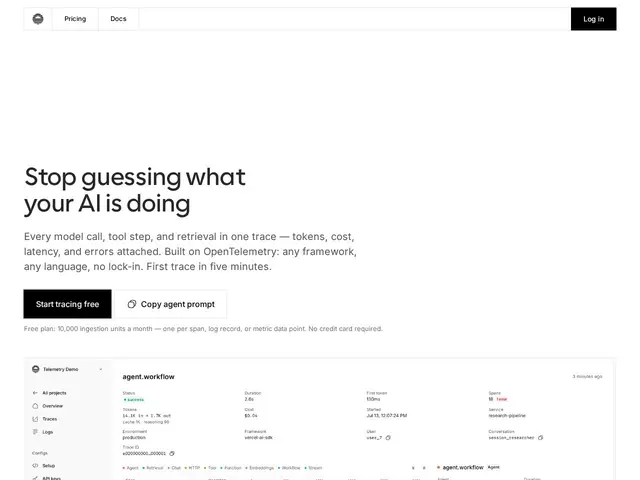
Description
Once an AI app is calling multiple models, chaining tool calls, and pulling in retrieved data, figuring out why a response was slow, wrong, or expensive becomes genuinely hard with generic logging — you need to see the whole chain of model and tool calls as it actually happened. Telemetry.dev builds that view specifically for AI apps, capturing every model call and tool interaction as an OpenTelemetry trace you can inspect as a waterfall.
It automatically tracks cost across more than 8,600 model identifiers — separating input, output, cached, and reasoning tokens, which matters a lot now that reasoning tokens can dominate a bill — alongside standard performance metrics like request volume, error rate, and p95 latency. It plugs into the major LLM providers (OpenAI, Anthropic, Gemini, Mistral, Cohere) and frameworks (LangChain, Vercel AI SDK) via drop-in TypeScript and Python SDKs, or standard OTLP if you're already emitting OpenTelemetry data. Privacy controls include per-environment capture settings, automatic secret redaction, and custom pattern matching before data is stored. The free tier covers 10,000 ingestion units a month with 7-day retention and no credit card required.
💬 Our review
The short version: Telemetry.dev is solving the same problem as Langfuse and Helicone — LLM-specific observability — with OpenTelemetry as its foundation rather than a proprietary format, which matters if you want to avoid vendor lock-in on your traces.
Against Langfuse (open-source-first, strong prompt-management features) or Helicone (simpler proxy-based logging), Telemetry.dev's edge is standards compliance: OTLP support means your traces aren't stuck in a proprietary schema, and the 8,600+ model cost catalog with reasoning-token separation is more granular than most competitors offer out of the box. The free tier's 7-day retention is tight if you need to debug an issue reported a week later — you'd need a paid tier for anything beyond quick, recent debugging. Worth adopting if you're already OpenTelemetry-native or want to avoid lock-in; Langfuse remains the stronger pick if prompt versioning/management is your primary need rather than tracing.
💰 Pricing
📊 Global score
🤖 AI-enriched data
Gratuit jusqu'à 10 000 unités d'ingestion/mois (1 par span/log/metric), rétention 7 jours, sans carte bancaire. Paliers payants pour plus de volume.
Pros
Basé sur le standard OpenTelemetry (OTLP), pas de format propriétaire
Suivi de coût sur 8 600+ identifiants de modèles, tokens reasoning séparés
SDKs drop-in TypeScript/Python + support des frameworks courants
Rédaction automatique de secrets, contrôles par environnement
Cons
Rétention gratuite limitée à 7 jours
Moins mature en gestion de prompts que Langfuse
Paliers payants nécessaires dès un volume de production réel