Radia
Open-source shared workspace where independent AI agents can publish, claim, and audit each other's work
🔗 Visit Radia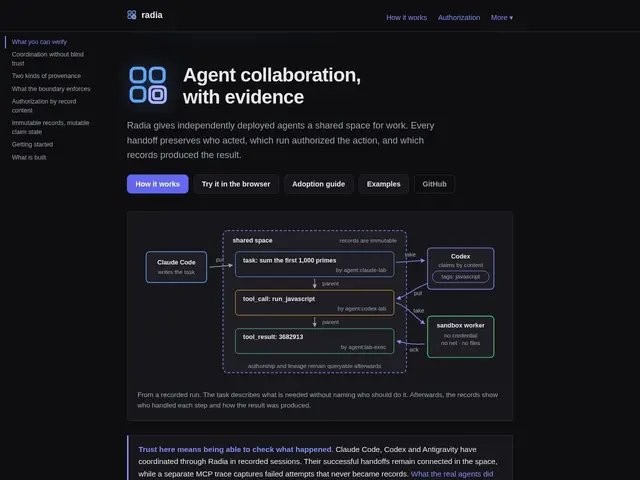
Description
Once you're running several AI agents that don't share a codebase or a deploy pipeline, coordinating who does what becomes a manual, error-prone process — there's no shared record of which agent claimed a task, whether it was authorized to, or what actually happened. Radia is an open-source workspace built to fix that: agents publish tasks, other agents claim the ones matching their capabilities and permissions, and every step is recorded in an immutable, auditable trail.
Its core idea is authorization and traceability by default: work discovery is pattern-based rather than hardcoded to specific agent names, access is scoped to what a record's content actually permits, and "fenced leases" stop untrusted code from walking away with reusable credentials. Large results are handled via content-addressed artifacts rather than bloating the record chain, and a web console plus graph queries let you inspect the whole history after the fact. It's built on Deno with a choice of SQLite, PGlite, or PostgreSQL as the backing store, ships TypeScript and Python SDKs with zero external dependencies, and integrates with OIDC and MCP (Model Context Protocol). It's free and fully open source.
💬 Our review
The short version: Radia treats multi-agent coordination like a security and audit problem first, a task queue second — which is the right instinct once agents are making autonomous decisions with real consequences.
The closest comparison is Bridle, another protocol tackling agent-to-agent coordination — but Bridle is about consent-based direct handoffs between two agents, while Radia is a shared workspace model where any qualifying agent can claim published work, with the audit trail as the central feature rather than an add-on. Against generic job queues (Celery, Redis-backed queues), Radia's content-scoped authorization and immutable record chains are built for a world where you don't fully trust every agent touching the queue — a real requirement once agents run with meaningful permissions. It's overkill for a single trusted agent doing sequential work; it earns its complexity once multiple independently-deployed agents need to share a workload without stepping on each other or exceeding their authorization.
💰 Pricing
📊 Global score
🤖 AI-enriched data
Gratuit, aucun modèle de tarification, projet open source.
Pros
Chaînes de records immuables et auditables par défaut
Autorisation scoped-au-contenu + baux fenced contre le code non fiable
SDK TypeScript et Python, zéro dépendance externe
Choix de backend (SQLite/PGlite/PostgreSQL), intégration OIDC + MCP
Cons
Complexité superflue pour un agent unique traitant du travail séquentiel
Écosystème jeune, peu d'intégrations tierces documentées
Nécessite de comprendre son modèle d'autorisation avant de l'adopter en production