Kintools
Zero-dependency, type-safe TypeScript libraries for form and state management that work with any framework
🔗 Visit Kintools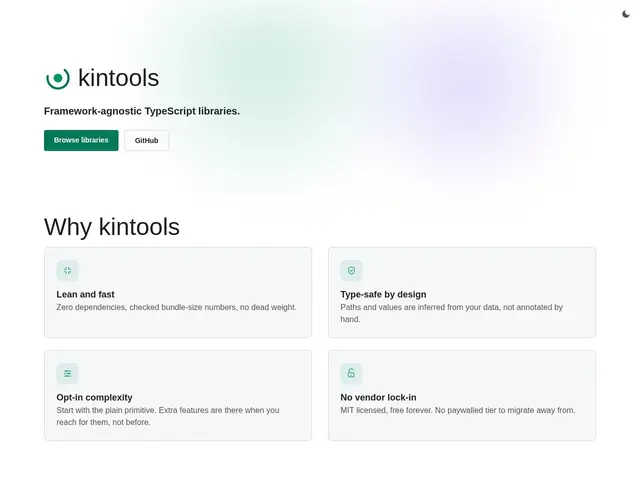
Description
Form and state management libraries often force a trade-off: either you get strong TypeScript inference and end up locked into one framework's ecosystem, or you get framework-agnostic flexibility and lose type safety along the way. Kintools tries to give you both, with two small, zero-dependency libraries: Kin Form for form state and Kin Store for reactive state management.
Both libraries infer types from your actual data shape rather than requiring manual type annotations, keep bundle size explicitly checked and minimal, and work across React, Lit, and the broader JavaScript ecosystem rather than being tied to one framework. It's MIT-licensed, free, and shows active development (copyright line reads 2026-present) with working documentation and a functional GitHub presence.
💬 Our review
The short version: Kintools' pitch — zero dependencies, strong type inference, framework-agnostic — is exactly what a lot of developers want from state/form libraries but rarely get all three at once.
Against Zustand (reactive state, React-focused, larger community) or React Hook Form (forms, React-focused, very mature), Kintools' framework-agnostic design is the real differentiator if you need the same state/form logic to work across React and non-React parts of your stack (e.g., a Lit-based design system alongside a React app). The trade-off is exactly what you'd expect from a newer library: a much smaller community than Zustand or React Hook Form means fewer Stack Overflow answers, fewer third-party integrations, and more risk if you hit an edge case the maintainer hasn't seen yet. Worth trying if framework-agnosticism is a real requirement for you; stick with Zustand or React Hook Form if you're purely React and want the safety of a larger ecosystem.
💰 Pricing
📊 Global score
🤖 AI-enriched data
Licence MIT, gratuit.
Pros
Zéro dépendance externe, taille de bundle vérifiée et minimale
Inférence de type depuis la forme des données, pas d'annotation manuelle
Fonctionne avec React, Lit et l'écosystème JS plus large
Gratuit, MIT, développement actif
Cons
Communauté bien plus petite que Zustand ou React Hook Form
Moins d'intégrations tierces et de réponses communautaires disponibles
Projet plus jeune, moins de retours d'expérience en production à grande échelle