WorldCut
Verifies that independent systems agree on the same version and timing before an automated decision proceeds
🔗 Visit WorldCut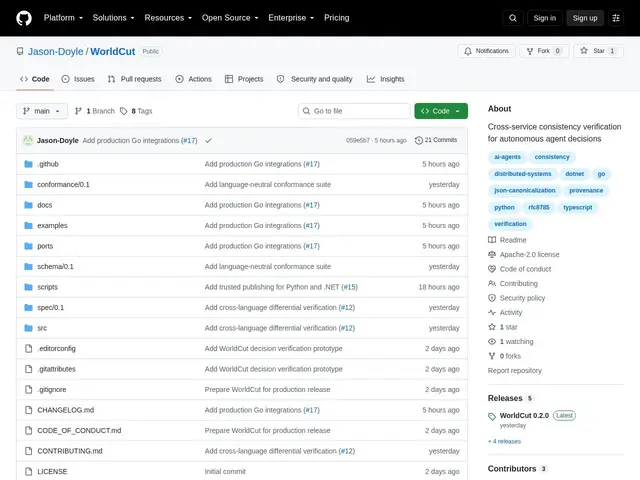
Description
When an automated pipeline or agent makes a decision based on data from several independent systems — a Git commit, an HTTP API response, a Kubernetes resource state — there's a real risk those observations aren't actually consistent with each other: one might be stale, or from the wrong version, or simply contradict another. WorldCut checks that consistency explicitly before letting the decision proceed, instead of assuming it's fine.
It evaluates three kinds of requirements — dependency checks, common valid-time validation (do these observations describe the same point in time), and value equality — and returns one of three clear verdicts: CONTRACT_SATISFIED, CONTRACT_VIOLATED, or INSUFFICIENT_EVIDENCE, so a calling system knows exactly what to do next rather than getting a vague pass/fail. It ships metadata adapters for Git, HTTP, and Kubernetes resources, plugs into GitHub Actions as a deployment gate, and supports an "Agentic Data Kernel" adapter for AI-agent pipelines specifically. The reference implementation is TypeScript, with production-ready ports to Go, Python, and .NET, all passing conformance and differential testing against each other. It's open source, free, at version 0.1 with 21 commits and active CI/CD workflows.
💬 Our review
The short version: WorldCut is solving a subtle but real correctness problem — that data from independent systems can silently disagree on version or timing — that most pipelines currently just don't check for at all.
There's no widely-known direct competitor doing exactly this cross-service consistency verification; the closest comparison is a policy engine like Open Policy Agent (OPA), which checks whether a state satisfies a policy but doesn't specifically verify version/time consistency across independent data sources the way WorldCut does. Most teams currently handle this implicitly (or not at all) by trusting that if a deployment gate passed, the underlying data was consistent — which is exactly the assumption WorldCut is built to stop making. It's early (v0.1, 21 commits) and its value is highly dependent on how much your pipeline actually pulls state from multiple independent systems before making an automated decision; if you only have one source of truth, this doesn't apply to you yet.
💰 Pricing
📊 Global score
🤖 AI-enriched data
Gratuit, open source, aucune tarification.
Pros
Verdicts explicites (CONTRACT_SATISFIED/VIOLATED/INSUFFICIENT_EVIDENCE) plutôt qu'un pass/fail vague
Ports Go/Python/.NET testés en conformité différentielle avec la référence TypeScript
Adaptateurs Git, HTTP, Kubernetes + intégration GitHub Actions comme porte de déploiement
Gratuit, open source, support spécifique pour pipelines d'agents IA
Cons
Projet très jeune (v0.1, 21 commits)
Valeur nulle si votre pipeline n'a qu'une seule source de vérité
Concept nouveau, nécessite de comprendre son modèle de contrat avant adoption