Saccade
A browser control runtime that gives AI agents a constrained, verified view of a single authorized Chrome or Edge tab, with local action validation and stale-object recovery built in.
🔗 Visit Saccade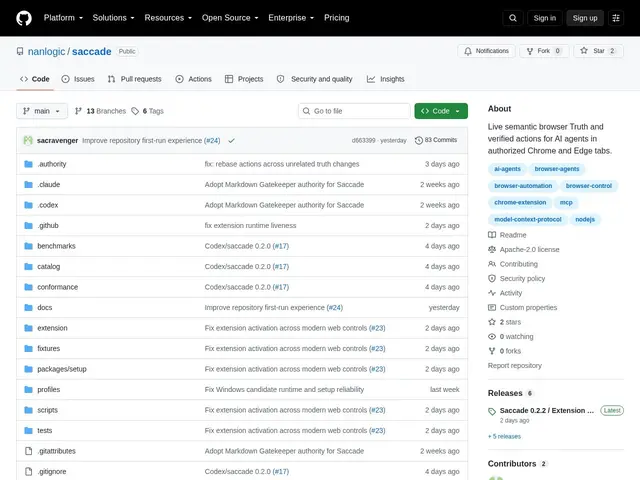
Description
Letting an AI agent click and type in a real browser session — one that's actually logged into your accounts — is risky if the agent can wander to other tabs or act on a page element that changed since it last looked. Saccade narrows that risk by giving the agent a tightly fenced, verified window into exactly one tab, instead of open-ended control over the whole browser.
Saccade is a closed-loop browser control runtime exposing six MCP tools for capability checking, tab management, reading page state, and executing verified actions on a single authorized Chrome or Edge tab per session. It validates actions locally before execution — checking visibility, enabled state, geometry, and authority — and pushes page-state updates to the agent instead of relying on polling, with stale-object detection and safe recovery when the page changes underneath it. It reports 96/96 mouse accuracy with 7-8ms mean latency for exact-target actions, and supports batch field operations across text inputs, checkboxes, selects, ARIA components, tables, iframes, and shadow roots. It's free and open source under the Apache-2.0 license.
💬 Our review
The short version: Saccade is a narrower, more cautious tool than general browser-automation frameworks like Playwright or Puppeteer — it's built specifically for AI agents acting inside a real, authenticated user session, where the cost of a wrong click is much higher than in a test-automation script.
Playwright and Puppeteer are the default choice for scripted, deterministic browser automation and have far larger ecosystems, but they weren't designed with an AI agent's failure modes in mind — a stale element reference or a misjudged click target just throws an error rather than being caught and safely recovered. Newer AI-browser-agent frameworks like Stagehand solve a similar problem but usually lean more on vision-model queries per action; Saccade's local validation and single-tab authorization model trade some flexibility for tighter safety guarantees and lower latency. It's a reasonable choice if you're building an agent that operates inside a real, logged-in browser session and need strong guardrails against acting on the wrong element; if you're just automating a test suite with no real user session at stake, Playwright remains the simpler, more established option.
💰 Pricing
📊 Global score
🤖 AI-enriched data
Open source, licence Apache-2.0 — aucun coût.
Pros
Vue restreinte à un seul onglet autorisé par session
Validation locale des actions avant exécution (visibilité, état, géométrie, autorité)
Détection d'objets obsolètes avec récupération sûre
Mises à jour d'état poussées par le navigateur plutôt que du polling
96/96 précision souris, 7-8ms de latence moyenne
Cons
Écosystème et documentation bien plus restreints que Playwright/Puppeteer
Limité à Chrome et Edge
Scope volontairement étroit — pas un remplaçant généraliste pour du test automation