49 Agents IDE
A 2D agentic IDE with an infinite zoomable canvas that consolidates multiple terminals, projects, and machines into one workspace, with real tmux sessions and zero-SSH multi-machine connectivity.
🔗 Visit 49 Agents IDE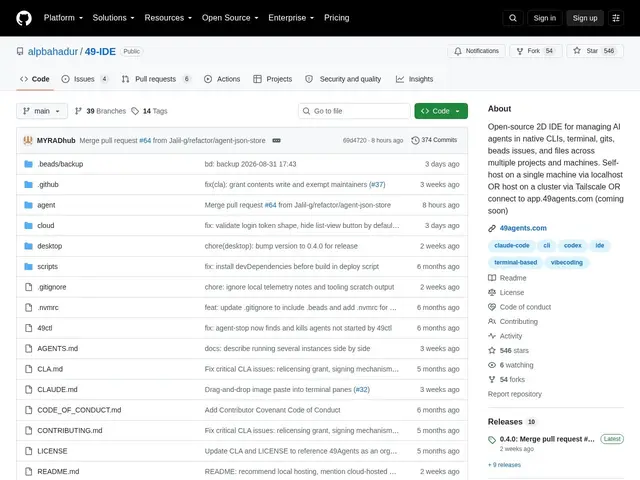
Description
Developers juggling several AI coding agents across multiple projects and machines usually end up buried in terminal tabs and SSH sessions, switching context constantly and losing track of what's running where. 49 Agents IDE replaces that flat stack of tabs with a spatial canvas you can pan and zoom, treating each terminal or project as an object you place and arrange rather than a tab you cycle through.
49 Agents IDE is a 2D agentic IDE built around an infinite zoomable canvas that consolidates real tmux terminal sessions (with full ANSI color support), multiple projects, and multiple machines into a single workspace, connecting to remote machines without requiring SSH. It supports broadcasting input to multiple terminals at once, cross-device use on laptops, tablets, and phones, a live HUD showing CPU, RAM, and Claude API usage, keyboard-first navigation with tab chords and WASD movement, a Monaco editor embedded directly on the canvas, and git graph and table visualization. It's open source under BSL 1.1 — free for individuals and small teams, converting to MIT on February 26, 2030 — with both self-hosted and cloud deployment options.
💬 Our review
The short version: 49 Agents IDE is betting that a spatial, zoomable canvas is a genuinely better mental model than tabs and splits once you're running many terminals and AI agents across multiple machines at once — and for that specific scenario, the pitch is plausible.
Traditional terminal multiplexers like tmux and Zellij are the direct comparison, and they're what 49 Agents IDE is built on top of (real tmux sessions) rather than replacing outright — the value-add is the spatial canvas layer and zero-SSH multi-machine connectivity on top of that familiar foundation. Warp offers a more polished single-machine terminal experience with AI features baked in, but doesn't tackle the multi-machine, multi-project spatial organization problem this tool targets. The zero-SSH connectivity claim is the most interesting differentiator if it holds up in practice, since SSH session management is a real point of friction for distributed agentic workflows. The BSL 1.1 license (converting to MIT in 2030) is free for individuals and small teams but worth reading closely if you're a larger organization. Worth trying if you're actually running many terminals and agents across several machines simultaneously; overkill if you work on one project on one machine at a time, where a normal terminal or tmux setup is simpler.
💰 Pricing
📊 Global score
🤖 AI-enriched data
Open source sous licence BSL 1.1 — gratuit pour individus et petites équipes ; conversion en MIT prévue le 26 février 2030.
Pros
Canvas 2D infini zoomable pour organiser terminaux/projets spatialement
Vraies sessions tmux avec support ANSI complet
Connectivité multi-machines sans SSH
HUD live (CPU, RAM, usage API Claude)
Compatible multi-appareils (laptop, tablette, téléphone)
Cons
Licence BSL 1.1 à vérifier pour un usage en grande organisation
Courbe d'apprentissage pour un paradigme d'interface non conventionnel
Sur-dimensionné pour un usage mono-projet / mono-machine